Most freelancers in Jordan assume the invoicing rules start somewhere above them. They look at the thresholds, decide they are too small to matter, and keep sending a PDF they built in a word processor. That assumption is the single most expensive mistake a one-person business can make here, because Jordan’s mandate was never written around size.
Since 1 April 2025, every invoice for goods or services in Jordan has to be issued through the National Invoicing System (JoFotara), run by the Income and Sales Tax Department (ISTD). The scope covers business-to-business, business-to-consumer and business-to-government sales alike. It also covers professionals: consultants, designers, engineers, doctors, translators, trainers, developers. If you sell a service and issue a document for it, you are inside the system.
So the useful question for a freelancer or a sole proprietor is not “am I covered”. It is “which invoice do I issue, and how do I start”. This guide answers exactly that. For the generic requirement set, the full field list and the long-form connection walkthrough, we link out rather than repeat: the complete guide to Jordan’s e-invoicing requirements already covers that ground in depth.
You are covered by the mandate, and registration status has nothing to do with it
This is the point where Jordan diverges sharply from the way e-invoicing works in some neighbouring markets. There is no link between the invoicing obligation and registration for General Sales Tax (GST). The obligation attaches to the act of selling, not to a tax file.
The regulation is blunt about the floor. Under article 5(a) of the Regulation for Organizing and Controlling Invoicing Affairs, a seller of any good or service worth not less than one Jordanian dinar must issue an invoice, in at least two copies. Article 2 of the executive instructions repeats the same one-dinar floor. There is no monthly minimum, no annual revenue gate, and no carve-out for someone who invoices twice a month.
What changes with GST registration is the type of invoice you issue, not whether you issue one:
| Your status | The document you issue | Tax on the invoice |
|---|---|---|
| Registered for General Sales Tax | A general sales tax invoice (فاتورة ضريبة المبيعات العامة) | GST at the applicable rate, 16% as the standard rate |
| Not registered for General Sales Tax | An income invoice (فاتورة دخل) | None. The invoice lines carry no tax block at all |
Read that second row again, because it is the part that trips people up. Not being registered does not excuse you from the system. It moves you to a different document inside the same system. You still register with JoFotara, you still transmit the invoice, and you still get an approved invoice back.
Tax invoice or income invoice: the decision that shapes your whole setup
Getting this wrong is not a cosmetic error. The two families are different document types in the system, and sending the wrong one comes back as a rejection with the message “This user is not authorized to submit this type of invoice”. That is the ISTD technical manual’s own listed cause: an income invoice sent by a GST-registered taxpayer, or the reverse.
The practical rule is simple. Your registration status with the ISTD decides the family, and you do not get to choose.
When does a freelancer become GST-registered?
Jordan’s registration thresholds sit in article 13 of the General Sales Tax Law, and they are measured on annual taxable turnover. For services, which is where most freelance and professional work lands, the threshold is JOD 30,000. For goods other than those carrying special sales tax, it is JOD 75,000. Manufacturers of goods subject to the special sales tax register at JOD 10,000, and importers have no threshold at all: they register within 30 days of their first import. If you run more than one activity, the lowest applicable threshold is the one that binds you. Voluntary registration is also available under article 14.
So a designer billing JOD 18,000 a year issues income invoices. The same designer crossing JOD 30,000 in annual service turnover registers for GST and moves to tax invoices at 16%. The invoicing obligation itself never moved. Only the document type did.
One technical consequence worth knowing before you pick software: an income invoice carries no tax block on its lines at all. Quantity, unit price, discount and item name, and nothing else. A system that assumes every invoice has a tax total will fight you on every send. If you want to sanity-check where you stand before you commit, the JoFotara readiness check walks the same decision in a couple of minutes, and the guide to income tax in Jordan covers the brackets and the annual return that sit behind the income-invoice side.
The exemption lists, in numbers, and why no freelance category is on them
People hear “there are exemptions under 75,000 dinars” and stop listening. That sentence is wrong in a way that matters, and the wrongness is structural: the exemption is activity-based, not size-based. The threshold is a ceiling applied to a named activity. It is not a general small-business allowance.
Here is what the instructions actually say, in article 4:
- Under JOD 75,000 in annual sales, and only for nine named licensed activities: groceries (mini-market, supermarket or corner shop), bookshops and stationery shops, greengrocers, houseware shops, bakeries, popular restaurants, home-based work, dairy shops, and sewing-supplies shops.
- Under JOD 30,000 in annual revenue, for licensed crafts in any governorate of the Kingdom.
- Under JOD 150,000 in annual sales, for bakeries that sell bread only.
Three conditions sit on top of those numbers, and each one narrows the exemption further.
First, the licence alone does not carry it. Article 11(a) of the regulation requires the business to be actually practising the named activity. A licence in a drawer is not an exemption.
Second, the list is not closed. Later amendments added further commercial sectors under the 75,000 ceiling, including clothing and embroidery shops, footwear, electrical supplies, toys, coffee roasters and drinking-water treatment. Because the list has been amended before and can be amended again, the only safe move is to check the current text at the ISTD rather than trusting any list you read anywhere, this one included.
Third, an exemption is never permanent. Article 11(b) lets the Director impose the obligation on a person who is not otherwise bound, once there is sufficient evidence that their sales exceed the ceiling. And article 11(c) works in the other direction: an exempt party may apply in writing to issue invoices voluntarily. Neither direction is automatic, and neither is a once-and-done status.
Now put a freelancer against all of that. Read the nine activities again. Every one is a licensed retail or trade activity with a physical shop or a licensed craft. There is no freelance category, no professional category, and no consulting, design, engineering, medical or technical category on any exemption list. The gap is not an oversight you can argue into. The official scope statements point the other way: professionals are named as being inside the mandate.
A software developer billing JOD 12,000 a year is therefore not exempt, while a greengrocer billing JOD 60,000 a year may be. That reads as unfair until you remember what the lists are for. They exempt high-volume, low-value, cash-counter activities where per-sale invoicing would be unworkable. Professional work is the opposite shape: fewer invoices, larger values, and a named client on every one.
Lawyers: the one profession with a rule of its own
There is exactly one professional carve-out in the text, and it belongs to lawyers. Under article 6 of the instructions, a receipt voucher is accepted in place of an invoice for any lawyer whose collected revenue does not exceed JOD 50,000 per year.
Above that, the mechanism switches. A lawyer whose collected revenue passes JOD 50,000 must start issuing invoices under article 5 within forty-five days of reaching that threshold. The same forty-five-day window applies to correcting the position, and if collected revenue later falls back, the status is adjusted accordingly. Failure to comply routes to the same fines as everyone else, under article 64 of the Income Tax Law.
Note what this exception is not. It is not a professional exemption, and it does not generalise to consultants, accountants or engineers by analogy. It is a named rule for a named profession, with its own ceiling and its own deadline attached.
Getting onto JoFotara: the short version
The registration path is the same for a one-person business as for a company, which is why we keep it brief here. The step-by-step JoFotara connection guide runs the whole procedure, including the password rules and the main-user versus sub-user distinction that generates most of the support tickets.
What is different for a one-person business is not the procedure but the aftermath. A company hands the credentials to an IT team; you hand them to yourself. That makes two decisions yours alone: where those credentials live, and what issues the invoice once they are in place.
The registration itself is form-filling. The part that stalls people is the step after it, deciding whether the portal or your own system will hold the connection. That is the question the rest of this guide is really about.
In outline:
- Register or log in at the National Invoicing System through the ISTD e-services.
- Open device linking and generate a Client ID and a Secret Key.
- Complete the technical requirements, which in practice means handing those credentials to your accounting system or your developer.
- Issue your first invoice and confirm that an approved QR comes back.
Two cautions the ISTD manual is explicit about. Confidentiality of the Client ID and Secret Key sits entirely with the taxpayer, who bears full responsibility for any unauthorised use, so those two strings never belong in a shared spreadsheet or a chat thread. And the ISTD itself expects the taxpayer to coordinate with their own software provider to complete the technical side. That expectation is the whole reason the integration question below matters.
What actually happens when you issue an invoice
Jordan runs a clearance model, not a reporting one. The invoice has to be validated by the system before you share it with your client. That single sentence carries most of the operational consequences.
Underneath, the mechanics are these. The invoice is built as UBL 2.1 XML, encoded to Base64, and posted inside a JSON body to the ISTD endpoint with two headers: your Client ID and your Secret Key. The invoice’s primary key is its ID and UUID together, the UUID is generated by your system, and a counter travels with it.
For a freelancer, though, the XML is the least interesting part of that description, because a system handles it. What matters is what the clearance model takes off your plate and what it puts on it, and on both counts Jordan asks less of you than the market assumes. Three points carry almost all of it.
- There is no digital certificate for you to buy. Version 1.5 of the official technical manual asks the taxpayer to sign nothing. No XAdES, no X.509, no cryptographic stamp on your side. The signed document comes back from the ISTD. If a vendor tells you that you need to purchase a signing certificate to comply in Jordan, they are describing a different country’s system.
- The QR code is not yours to make. It is returned by the ISTD after the invoice is approved, in the response field, and your system prints it on the invoice. No approved QR means no legal invoice. This is also why a failed send is not a paperwork problem you can paper over: there is nothing to print.
- Verification runs through one app only. The manual’s own word is “only”: a QR is checked by scanning it with the Sanad app, under the digital-document verification option. A generic QR scanner will not do it. The app either reports that the document is valid and displays the basic invoice data carried inside the code, which is the invoice total, the invoice number, the tax total, the invoice date, the seller’s tax number and the seller’s name, or it reports an error because the code is unreadable or not tied to the national system. The full guide to verifying an e-invoice with Sanad covers both outcomes in detail, which is worth knowing when a client asks you to prove an invoice is genuine.
One more thing that surprises people building their own solution: there is no ISTD sandbox. No test environment appears anywhere in the official manuals. Whatever you send, you send to production.
The five mandatory fields come from article 5(a) of the invoicing regulation. The approved QR comes back from the tax department after the invoice is accepted.
- A sequential invoice number
- Your full name as registered, and your address
- Your tax number if GST-registered, or your national number if not
- The date the invoice was drawn up and issued
- The good or service, its quantity, its value and the total
- The QR code returned by the tax department after approval
Corrections, returns, and the things you simply cannot do
Freelancers correct invoices more often than they expect to. A scope changes, a client disputes a line, a rate was agreed differently. Jordan’s system is narrow here, and knowing the boundaries in advance saves a lot of improvisation.
The reason it needs thinking about in advance is that a clearance model closes the door behind each invoice. Once the ISTD has approved a document and returned its QR, that document is fixed: it exists in the national system exactly as it was sent, and nothing you do locally changes it.
Every correction is therefore a second document pointing at the first, and four boundaries follow from that. All four are narrower than the habits most people bring from a word processor, and none of them has a workaround inside the system: the boundary sits in the specification, not in your software.
- An issued invoice cannot be edited. The only correction route is a return invoice, which is legally a credit note, referencing the original invoice’s ID, UUID and total, with a mandatory free-text reason. Our note on editing an issued invoice in the National Invoicing System spells out what remains possible and what does not.
- Returns work on quantities only. You cannot return more than the quantity originally sold, though multiple partial returns against one original are allowed until the quantities are exhausted.
- There is no debit note. The official technical manual defines two invoice type values and no more: a new invoice, and a return invoice. If you need to charge a client more, that is a new invoice, not an upward adjustment to an old one.
- There is no invoice-level discount. The system does not accept one. If you agree a discount on the whole engagement, your system has to distribute it across the lines before sending. A freelancer who habitually writes “less 10% goodwill” at the bottom of a PDF has to change that habit.
One more operational rule that costs people real money: if a send fails, resend with the same ID and UUID. Minting a fresh UUID on a retry is the documented way to create duplicate invoices in the system.
The record keeping a one-person business actually owes
The invoice is drawn up in at least two copies, one delivered to the buyer. The buyer’s name is mandatory on any deferred, instalment or staged sale, which describes much freelance work. Above JOD 10,000, the seller must establish that the buyer received it, so keep the evidence.
Retention runs four years from the latest of the end of the tax period, the filing of the return, or notification of an administrative assessment, and longer where a dispute is unresolved. Then the provision that changes the paperwork: under article 8(b), data held in the national invoicing system is accepted in place of keeping the invoice on paper. The shoebox of printed copies stops being a legal requirement.
Two more articles apply. Article 6 requires a register of sales invoices, on paper or computerised, headed in the seller’s name and carrying page number, buyer name, invoice number and total. Article 10 puts responsibility for the invoice matching the transaction on seller and buyer alike.
What non-compliance actually costs
The regulation sets no amounts. Article 15 defers to the Income Tax Law No. 34 of 2014, where two separate routes live, often confused.
First, the failure fine under article 64: additional tax of not less than JOD 200 and not more than JOD 500, the listed cases including refusing to issue an invoice when the beneficiary asks. Paragraph (b) doubles the amounts on repetition.
The second is heavier: under article 66, failing to issue a proper invoice is an enumerated act of tax evasion, penalised by a compensatory fine equal to the tax difference, with prison terms that escalate on repetition. Article 69 adds that a penalty does not discharge the tax.
Beyond the fines sit two commercial consequences. An invoice not issued through the national system is not accepted as a tax document, so your client loses the input deduction and cannot recognise the expense. Clients notice that quickly. Non-compliance also brings exclusion from government tenders, closing a category of work.
Keying into the portal by hand, or connecting your accounting system
The free government portal is a legitimate route: it satisfies the law, costs nothing, and for three invoices a month may genuinely be enough. There is also an official mobile app.
The portal’s cost is not a fee but duplication: it does not know your books. Every invoice gets keyed twice, once where you track income and once into the portal. Receivables live in one place and compliance in another, and reconciling them at year end is the real cost. The article on whether the national invoicing portal is enough or you need an accounting system works through that threshold, and if you sell over a counter, the guide to choosing a point-of-sale system in Jordan that works with JoFotara covers the same trade-off at the till.
The alternative is a system that holds your customers, invoices and expenses, and sends each to the ISTD using your own Client ID and Secret Key. One entry, one record, one approved QR on the document your client receives.
How Qoyod helps a freelancer or sole proprietor in Jordan
Qoyod in Jordan is built around exactly this problem: compliance and bookkeeping in the same system rather than two disconnected ones. For a one-person business, the parts that matter are these.
Two things make a freelancer’s setup different from a company’s, and both are about where the work lands rather than which features exist. The first is that nobody re-keys anything for you: if compliance and bookkeeping live in separate places, you are the integration between them, every week. The second is that your invoicing happens wherever you happen to be, which is not always at a desk.
So the list below is written against those two constraints rather than as a feature inventory. If you issue a handful of invoices a month to retainer clients, the first three items decide your month; the rest become useful as the work grows.
- A live integration with the National Invoicing System. You enter your Client ID and Secret Key once in the integration settings, and invoices go to the ISTD as you issue them, with the approved QR printed on the document.
- Both invoice families, without a workaround. The Jordan tax engine runs General Sales Tax at 16% with the reduced, exempt and zero-rated cases, and the document set follows the system: income invoice, general sales tax invoice, special tax invoice and credit note. If you are not GST-registered today and register later, the invoice type changes without you rebuilding anything.
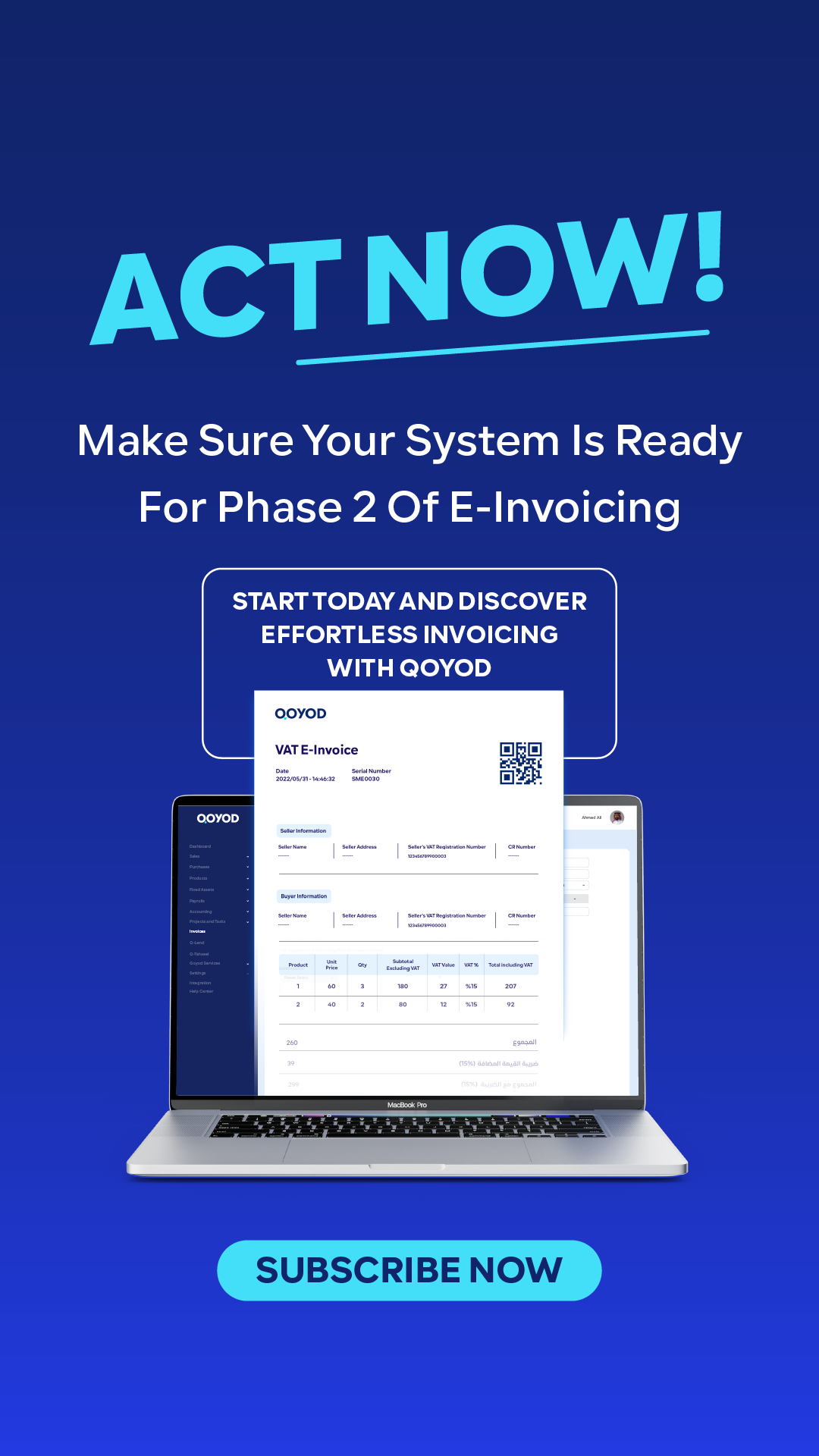
- A Jordanian invoice template. Tax number, bilingual Arabic and English layout, the mandatory fields, and the QR returned by the tax department in its place.
- Recurring invoices and payment reminders. Retainer clients get invoiced on schedule instead of whenever you remember, and overdue invoices chase themselves.
- Expenses, multi-currency and reports in the same file. Bill a client abroad in dollars or euros, record your own costs against the same books, and pull the income statement without exporting anything.
- Mobile apps for iOS and Android, which matters when you are invoicing from a client’s office rather than a desk.
- An API and Zapier if you sell through an online store or a booking tool and want the sale to land in your books on its own.
If you would rather see the accounting side first, the cloud accounting software overview covers the modules underneath all of this, from the chart of accounts to the reports.
Frequently asked questions
I am a freelancer and I am not registered for General Sales Tax. Am I exempt from e-invoicing?
No. Registration status decides which document you issue, not whether you issue one. Not being registered puts you on the income invoice, which carries no tax, and you still issue it through the National Invoicing System.
My annual income is well under JOD 75,000. Doesn’t the exemption cover me?
Not by itself. That ceiling applies only to nine named licensed activities such as groceries, bakeries and greengrocers, and it requires you to be actually practising that activity. Freelance and professional work is not on the list.
Do I need to buy a digital signature certificate?
No. The official technical manual asks the taxpayer to sign nothing. The signed document is returned by the tax department. A certificate requirement belongs to a different country’s system, not to Jordan’s.
Where does the QR code on my invoice come from?
From the tax department, in the response after your invoice is approved. Your software prints it. It is not generated locally, and an invoice without it is not a valid document.
How does my client verify the invoice I sent?
By scanning the QR with the Sanad app, under the digital-document verification option. The manual specifies that app only. The result either confirms the document is valid and shows the basic invoice data carried in the code, or reports an error.
Can I edit an invoice after I have issued it?
No. The only route is a return invoice, which is a credit note referencing the original, with a mandatory reason, and it works on quantities only. There is no debit note in the system.
I am a lawyer. Do the same rules apply to me?
Only partly. A receipt voucher is accepted in place of the invoice while your collected revenue stays at or below JOD 50,000 a year. Above that, you have forty-five days from reaching the threshold to start issuing invoices under article 5.
What happens if I keep invoicing outside the system?
Two things, and they stack. Your invoice is not accepted as a tax document, so your client loses the deduction. And you are exposed to a fine of JOD 200 to 500 that doubles on repetition, with the separate tax-evasion route carrying a compensatory fine equal to the tax difference.
Where to start this week
If you are a freelancer or a sole proprietor in Jordan, the sequence is short. Confirm your GST registration status, because that is what decides your document type. Confirm that none of the named exemption activities describes what you actually do, which for professional work it will not. Then register with the National Invoicing System, generate your credentials, and decide whether you are keying invoices by hand or connecting the system that already holds your books. While you are at it, the Jordan income tax calculator is a quick way to see what the income-tax side of the same year looks like.
The mandate did not arrive with a grace period for small operators, and there is no threshold below which it stops applying to you. The good news is that the obligation is a one-time setup, not an ongoing burden: once the connection is live, a compliant invoice is the same click as any other invoice.