




An inventory count report template is an essential tool for any business that relies on storing products or raw materials in its daily operations.
This report represents the official document that records the results of the physical inventory count at a specific point in time.
The count report includes precise details about the stored materials, such as quantities, descriptions, and financial values, along with notes regarding any discrepancies between actual quantities and those recorded in the accounting books.
In business, inventory management is one of the critical operations that directly affects the financial and operational performance of companies.
For this reason, the inventory count report becomes indispensable for ensuring data accuracy and transparency in resource management.
Through this document, the “count template,” companies can precisely determine the size of their inventory, whether finished products ready for sale or raw materials awaiting the production cycle.
The Role of the Inventory Count Report in Inventory Management
The inventory count report plays an important role in improving inventory management overall. It is used not only to document what a company owns in materials or products, but it also helps improve the efficiency of operational processes.
For example, through regular counting, a company can identify materials that have fallen below safe levels and take the necessary actions to replenish inventory in time, preventing production stoppages or delays in fulfilling customer orders.
Beyond that, the inventory count report can reveal any damaged or unsellable materials, helping the company dispose of them in an organized way and reduce associated losses.
It also helps identify consumption patterns of materials and products, allowing management to improve purchase planning and reduce operational costs associated with storing unnecessary excess.
The inventory count report is considered an important organizational tool for managing inventory efficiently. It helps in:
- Identifying discrepancies: comparing physical inventory with inventory recorded in the accounting books to detect any differences or errors.
- Improving planning: providing accurate data that contributes to purchase planning and identifying future needs.
- Detecting damage and loss: helping identify inventory that may have been damaged, lost, or stolen.
- Strengthening control: reinforcing inventory control and preventing misuse or waste.
Importance of the Inventory Count Report Template in Maintaining Data Accuracy
The inventory count report template gains its importance from the pivotal role it plays in maintaining the stability of business operations.
On one hand, it helps ensure that the data recorded in the accounting system matches actual reality, preventing accounting errors that could affect financial and managerial decisions.
On the other hand, it provides an effective tool for identifying shortages or surpluses in inventory, enabling management to act quickly and address any potential issues.
In addition, the inventory count report is an essential part of preparing annual or periodic financial reports.
Through it, companies can present accurate data that reflects their true financial position. This accuracy is essential for compliance with international accounting standards such as IFRS or GAAP, ensuring highly credible financial reports that build trust between the company and stakeholders such as investors and banks.
These points can be summarized as follows:
- Ensuring accuracy in financial reports: preparing accurate financial reports depends on documenting inventory correctly. Errors in inventory may affect financial results and lead to poor decisions.
- Compliance with accounting standards: the inventory count report plays a decisive role in ensuring compliance with the requirements of accounting standards such as IFRS or GAAP, which require accurate data on assets.
- Evaluating financial performance: inventory is one of the main assets of companies. Therefore, evaluating its accuracy reflects on the overall evaluation of the company’s performance.
- Reducing financial losses: by documenting discrepancies and working to address them, the inventory count report helps reduce waste and potential losses.
Elements of the Inventory Count Report Template

The inventory count report template is a pivotal document used to document the actual quantities of materials or products available in warehouses.
To ensure accuracy and comprehensiveness, the inventory count report template must include a set of essential elements that cover every detail of the count.
Below is a detailed explanation of the elements of this template:
1. Basic Report Information
This section includes the identifying data of the report, which is the first part that makes it easy to distinguish between different reports and define their purpose. It includes:
- Company or entity name: to identify the entity where the count is taking place.
- Count date: to document the day the count was carried out.
- Report number: a reference number used to organize and make it easy to find the report later.
- Inventory location: identifying the physical location of the warehouse or unit being counted.
2. Inventory Data
This section represents the core of the report, where inventory details are recorded. It must include:
- Item number: a unique code used to identify the material or product (SKU).
- Item name: the full description of the product or material.
- Unit: the unit by which the item is measured, such as kilogram, piece, liter, and so on.
- Book balance: the quantity recorded in the accounting system or administrative records.
- Actual balance: the actual quantity found during the count.
- Count variance: the difference between the book and actual balance, which helps identify discrepancies.
- Notes: any additional notes such as the condition of materials, or the presence of damaged or unusable items.
3. Details and Analysis of Discrepancies
When there are differences between the actual and book balance, the report must include the following:
- Causes of discrepancies: analysis of the factors that led to the differences, such as damage, theft, or recording errors.
- Corrective actions: the steps that will be taken to address the discrepancies, such as adjusting records or reviewing processes.
4. Details of Those Responsible for the Count
To ensure reliability and accountability, the names and roles of those responsible for the count must be documented:
- Names of count team members: identifying the individuals who carried out the count.
- Signatures: signatures of all members confirming the accuracy of the information listed.
- Responsible supervisor: signature of the supervisor or manager in charge of inventory to make it official.
5. Additional Details (Optional)
The report may contain additional elements depending on the nature of the business and the company’s requirements:
- Linking the count to a specific project: if the count relates to a specific project or special order.
- Inventory status: such as quality level, validity, or any other relevant information.
- Inventory classification: classifying products into groups such as raw materials, finished products, and work-in-progress (WIP).
6. Verification and Certification
To give the report a legal and documentary character, it must include:
- Company stamp: to make it official.
- Management certification: signature of senior management as proof that the report has been reviewed and approved.
7. Attachments
If additional details are needed, attachments can be included with the report, such as:
- Photos of inventory, especially if there are damaged materials.
- Copies of invoices or records related to the inventory.
How to Prepare the Inventory Count Report Template
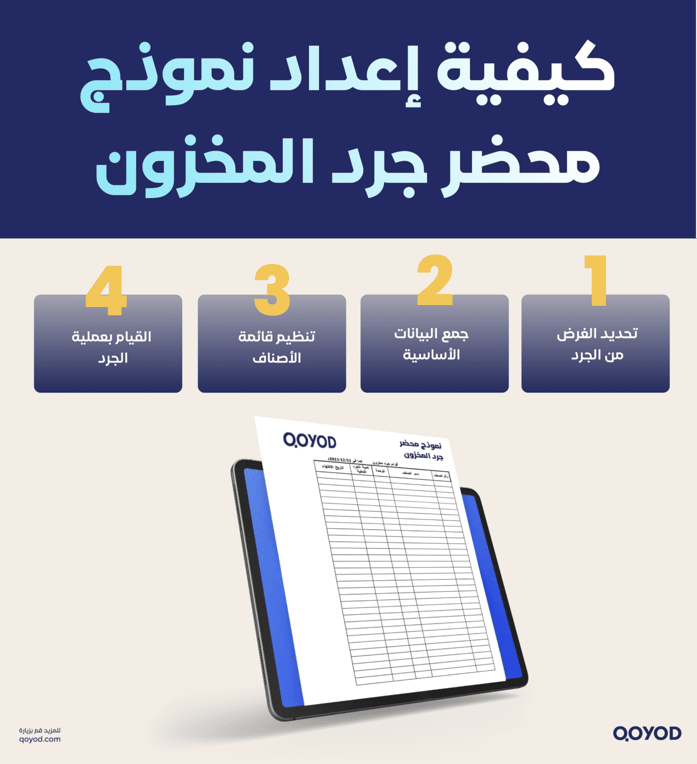
Preparing the inventory count report template is an essential process to ensure inventory is documented accurately and in an organized way.
This report helps companies track available materials and confirm they match official records.
Below are the detailed steps for preparing the template:
1. Practical Steps for Preparing the Inventory Count Report Template
A. Define the Purpose of the Count
- Type of count: is it a periodic, annual, or surprise count?
- Count objectives: determining actual quantities, detecting differences between actual and book records, evaluating inventory status.
B. Gather Basic Data
- Identify the location: specify the location or warehouse section that will be counted.
- Form the count team: choose a responsible team that includes a supervisor and trained staff to ensure accuracy.
- Prepare the tools: make sure all necessary tools are available, such as count lists, report templates, and measuring devices if needed.
C. Organize the Item List
- Identify items: prepare a list of all items in the warehouse based on book records.
- Define required fields: such as item number, product name, expected quantity, actual quantity, and discrepancies.
D. Carry Out the Count
- Physical counting: count all items manually or using electronic devices.
- Documentation: record the data accurately in the count report template.
- Quality check: verify the condition of materials such as validity or signs of damage.
2. Drafting a Table with Clear Data
Table Components:
- Item number: a unique identification number for each product or material.
- Item name: the name of the material or product as recorded in the books.
- Unit: the unit used to measure the item (piece, kilogram, liter).
- Book balance: the quantity recorded in the accounting or administrative records.
- Actual balance: the quantity found during the count.
- Variance: the difference between the book quantity and the actual quantity.
- Notes: an additional element such as the condition of materials or the reason for discrepancies.
Sample Inventory Count Table:
| Item number | Item name | Unit | Book balance | Actual balance | Variance | Notes |
|---|---|---|---|---|---|---|
| 101 | Printing paper | Ream | 100 | 95 | -5 | Shortage due to damage |
| 102 | Printer ink | Box | 50 | 50 | 0 | Matched |
| 103 | Archive files | Box | 20 | 18 | -2 | Delivered without recording |
3. Reviewing and Officially Documenting the Report
A. Review the Report
- Verify the data: review all numbers and recorded data to confirm accuracy.
- Reconcile records: compare the results with the book records to detect any discrepancies.
B. Approve the Report
- Signatures of those responsible: all members of the count team must sign the report to confirm the accuracy of the data.
- Management signature: signature of the supervisor or manager responsible for inventory to officially approve the report.
C. Retain the Report
- Archiving: keep a copy of the report within the company’s official files.
- Reporting: provide a copy to management for review and to take the necessary actions.
Benefits of Preparing the Inventory Count Report Template with These Steps
- Achieving accuracy: documenting inventory quantities accurately to avoid errors.
- Enhancing transparency: providing reliable data to management and regulators.
- Audit readiness: ensuring the company is prepared for any financial or administrative audit.
Preparing the inventory count report template in this way ensures organized operations, preservation of resources, and support for informed financial and managerial decisions.
Common Mistakes During Inventory Counting and How to Avoid Them
Inventory counting is a necessary process to maintain the accuracy of an organization’s financial and operational data.
However, some common mistakes can appear that affect the efficiency and quality of the process.
Below is an explanation of the most notable of these mistakes and how to avoid them:
1. Inaccurate Data Entry
One of the most common mistakes is the inaccurate entry of information during the count, such as recording quantities incorrectly or entering wrong numbers.
This may happen as a result of rushing or weak training of the count team.
Impact:
- It leads to inconsistencies in the financial records.
- It affects purchasing and sales decisions due to inaccurate data.
How to avoid it:
- Train the team: the team responsible for the count must be trained to use the dedicated systems and tools accurately.
- Use digital systems: rely on specialized accounting software, such as Qoyod, which allows accurate data entry with error checking.
- Double-check: review the data after entry by another team member to ensure its accuracy.
2. Failure to Update Records After the Count
After the count is complete, some may neglect to update the inventory or financial records based on the findings.
This leads to continued reliance on outdated and incorrect data.
Impact:
- It makes it difficult to make accurate strategic decisions.
- It negatively affects inventory monitoring and order fulfillment.
How to avoid it:
- Set clear update procedures: define team responsibilities for updating records immediately after the count.
- Integrate systems: use integrated accounting systems such as Qoyod to update records automatically as soon as count data is entered.
- Conduct periodic reviews: review records regularly to confirm they are updated in line with the count.
3. Lack of Transparency Between the Count Team and Management
The absence of effective communication between the count team and management can lead to misunderstanding of the requirements or objectives of the count, which may affect the efficiency and outcomes of the process.
Impact:
- Weak coordination leads to duplicated efforts or neglect of some warehouses.
- Inability to address issues discovered during the count.
How to avoid it:
- Strengthen communication: hold meetings before the count to clarify objectives, steps, and potential challenges.
- Real-time reporting: provide periodic reports to management during and after the count to make it easier to address issues quickly.
- Use unified software: rely on platforms such as Qoyod, which provides tools to track communication and manage tasks between different teams.
Frequently Asked Questions
What is an inventory count report?
An inventory count report is an official document that records the actual quantities of inventory at a specific point in time, compared to the book balance, to identify discrepancies and financial values. It is essential for accounting and operational accuracy.
What is the importance of the inventory count report in financial reporting?
It ensures the accuracy of financial data, compliance with IFRS or GAAP standards, and performance evaluation by exposing discrepancies, reducing losses, and supporting annual reports for stakeholders.
What are the essential elements of an inventory count report template?
It includes company information (name, date, number), inventory data (item number, name, unit, book/actual balance, variance, notes), details of discrepancies, signatures of those responsible, and attachments such as photos of damaged items.
How do you prepare an inventory count report step by step?
1. Define the purpose and the team; 2. Gather the item list; 3. Carry out the physical count and record it in a table; 4. Calculate the discrepancies; 5. Review and sign; 6. Update the records and archive.
An accurate inventory counting process requires planning and commitment to avoid common mistakes. Through proper training, continuous updating of records, and strengthened transparency, companies can improve the efficiency of their counts and reduce errors.
Turn your company’s internal audit process into a smooth and effective experience with Qoyod. Try Qoyod now for free!
Join our inspiring community! Follow us on LinkedIn and Twitter to be the first to see the latest articles and updates. An opportunity to learn and develop in the world of accounting and finance. Don’t miss out, join today!