




If you are looking for a real goods receipt note template, you are in the right place on the Qoyod blog, one of the leading sponsors of e-invoicing software in Saudi Arabia.
Here we present a ready-to-use template in PDF and Word formats that you can download and use directly, along with a practical guide on how to fill out the note, its legal and accounting importance, and expert tips to ensure procedural accuracy and protect the rights of all parties.
In the world of accounting and inventory management, official forms play a central role in safeguarding rights and documenting daily operations inside organizations and companies.
One of the most prominent and widely used of these forms is the goods receipt note, which is a cornerstone of the purchasing and inventory cycle, since it documents the moment goods are received from the supplier and ensures they match what was agreed in the invoice or purchase order.
This template is typically used by accountants, warehouse keepers, and purchasing managers, and even by small business owners who want to manage their commercial operations professionally.
For that reason, this article takes you on a complete tour of the goods receipt note, starting with its definition and importance, moving on to how to prepare and fill it out step by step, and finally giving you a ready template in PDF for printing and Word for direct editing and use inside your company.
The Goods Receipt Note: A Core Document in Accounting Work
In modern accounting, official forms and documents have become an integral part of the workflow inside companies.
These forms and official documents are not just papers filled with numbers; they are tools that ensure transparency, document commercial operations, and protect the rights of the different parties.
Among these vital documents, the goods receipt note stands out as one of the most important records relied upon by accountants, warehouse keepers, and suppliers in every supply or receipt operation.
Definition of the Goods Receipt Note
The goods receipt note is defined as an official accounting document prepared when goods or materials are received from the supplier, with the aim of confirming that the items and quantities received match what was stated in the purchase order or invoice.
It is usually signed by the warehouse employee or the person responsible for receiving, and it is considered legal proof that the company has actually received the goods according to the agreed specifications.
In short, it is a document that links the supplier and the recipient and ensures that the transaction was carried out transparently and credibly.
The Difference Between a Receipt Note, an Invoice, and a Purchase Order
Many people confuse these three terms, but they actually represent different stages of the purchasing cycle inside any organization:
- Purchase Order (PO)
This is the first step. The company issues it to the supplier to request the supply of certain goods at a specific quantity and price.
- Goods Receipt Note (GRN)
It is prepared once the shipment arrives, to confirm that it matches the purchase order. Here, the quantities, specifications, and quality of the goods are verified.
- Invoice
It is issued by the supplier after receipt is confirmed and is recorded in the company’s financial system so that payment can be made accordingly.
In general, the receipt note is the middle link that documents the verification of received goods before they are officially entered into the books or paid for.
- Learn more about the difference between a tax invoice and a simplified tax invoice
The Purpose of Using a Goods Receipt Note
The importance of this template lies in the fact that it acts as documented assurance between the company and the supplier.
Through it, you prove that the goods arrived intact, in the agreed quantities, and on time.
It also helps accountants update inventory records accurately and track the flow of items from suppliers to warehouses without errors or duplication.
In addition, having this note in place is essential in case any dispute arises with the supplier over quantities or specifications, since the document can be referred back to as conclusive evidence of what was actually received.
Who Uses This Template
The use of a receipt note is not limited to large companies; it also includes:
- Trading companies and factories that receive raw materials or products from suppliers.
- E-commerce stores that work with multiple warehouses and receive periodic shipments.
- Government entities that follow a formal procurement system.
- Accountants and financial auditors when reviewing documents and auditing accounts.
- Small business owners who want to manage their financial operations professionally.
Learn more about the e-invoicing system and the companies required to apply it
As a result, this template is indispensable for any organization that wants to run its operations according to sound accounting standards.
Core Components of a Goods Receipt Note
The ideal template consists of a set of fields that ensure the operation is documented accurately, and typically includes:
- Note number and date: for sequencing operations and time-stamping them.
- Supplier details: name, phone number, and reference invoice number.
- Goods details: item name, quantity, unit, price, and total.
- Recipient name and signature: to prove who actually received the goods.
- Additional notes: to record any remarks on the condition of the goods or packaging.
- Company stamp: to officially endorse the note within the organization’s records.
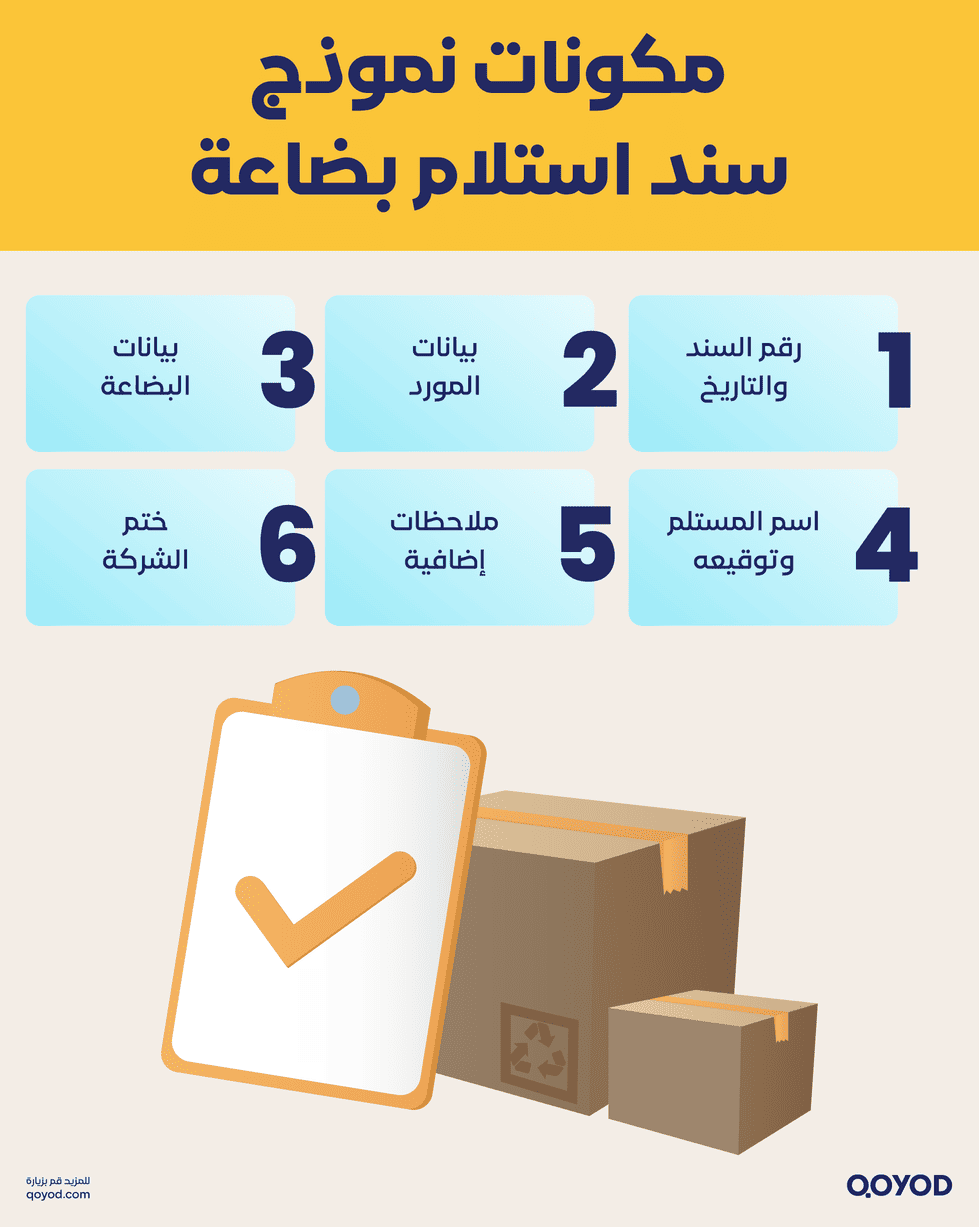
These elements form the foundation of any successful and well-defined receipt operation.
How a Goods Receipt Note Protects the Rights of the Company and the Supplier
This template plays a pivotal role in safeguarding the rights of all parties:
- For the company: it proves that the goods arrived as agreed, so the company is not held liable for additional costs or later claims.
- For the supplier: it confirms that delivery actually took place and that the company’s officials formally accepted the quantities.
- For the accountant: it serves as supporting documentation under which the goods are recorded as assets or inventory.
It also helps prevent manipulation or loss, since every receipt operation becomes documented by a note that carries a number, date, and approved signature.
Uses of the Goods Receipt Note in the Daily Accounting Cycle
In modern accounting systems such as the Qoyod accounting system, receipt notes are linked directly with invoices and purchase orders to make tracking easier.
When the receipt note is entered into the system, inventory balances are updated automatically and the invoice becomes ready for review.
This connection between the three documents (purchase order, receipt note, invoice) creates a complete accounting loop that ensures transparency and ease of review at any time.
- Learn more about creating a simple invoice using Qoyod
It is fair to say that the goods receipt note is not just a piece of paper; it is an important organizational and accounting tool that protects the rights of the parties involved, helps tighten the purchasing and inventory cycle, and forms the cornerstone of any successful accounting system.
How to Prepare a Goods Receipt Note Step by Step
Before starting to prepare any template, it is essential to recognize that the goods receipt note is not a mere formality. It is an official financial document recognized within the purchasing cycle in Saudi accounting systems.
When used correctly and properly documented, the goods receipt note supports the application of IAS 2 for inventory and is part of the documents that tax or customs authorities may request as supporting evidence for supplies.
For this reason, it must be prepared with great accuracy and signed by the authorized recipient, usually the warehouse keeper or purchasing officer, then approved by the finance department before being entered into the accounting system.
Preparation Before Issuing the Note
The process of preparing the note begins before the goods actually arrive, and includes:
- Reviewing the purchase order issued to the supplier and confirming the items, quantities, and prices agreed upon.
- Preparing the receiving area in the warehouse and getting the inspection team ready.
- Reviewing the initial invoice or shipping notice from the supplier to make matching easier.
All these steps ensure that the note will later be accurate and based on correct data.
Filling Out a Goods Receipt Note Step by Step
Once the goods are physically received, the note is prepared either manually or electronically through the accounting system, by filling in the following fields:
1. Note Number and Date
This is the first element on the template and is used to track the operation later in the system.
It is preferable to follow a clear sequential pattern such as (SR-2025-001), where SR stands for “Stock Receipt”.
2. Supplier Details
The basic information of the supplier is recorded here:
- Trade name.
- Commercial registration number or tax identification number.
- Associated invoice number or purchase order number.
This data makes it easier to link the note later with invoices and the e-invoicing system.
3. Details of the Received Goods
This is the heart of the note and includes:
- Item name: for example, “500 ml water bottle”.
- Quantity received: recorded in figures and units (carton, box, kilogram).
- Unit price: as agreed in the invoice.
- Subtotal for each item.
If there is more than one item, all of them are listed in a detailed table inside the note.
4. Special Notes
This field is used to record any comment regarding the condition of the goods (such as “incomplete packaging” or “received with notes from the quality team”, etc.).
These notes protect the company in case any problem appears later on.
5. Recipient Name and Signature
This is one of the most important legal fields on the note, as it represents the formal acknowledgment that the goods were received.
It is also preferable to add the employee’s name in clear handwriting along with their signature, plus a personal stamp or the finance department’s signature.
6. Company Stamp
This is what gives the note its official status and acceptance within the financial files.
In electronic templates, a digital stamp or e-signature is recognized as an official alternative.
The Difference Between Paper and Electronic Templates
Until recently, most companies used paper templates in all their operations.
However, with Saudi Arabia’s move toward digital transformation in accounting, especially after the rollout of e-invoicing (E-Invoicing), it has become essential for receipt notes to integrate with electronic accounting systems such as Qoyod.
The difference between the two types is as follows:
| Comparison | Paper Templates | Electronic Templates |
|---|---|---|
| Editing and Updating | Manual, and errors or duplication can occur | Done automatically inside the system |
| Storage and Archiving | Paper files that require space and physical storage | Stored securely in the cloud |
| Accounting Integration | Requires manual data entry for invoices | Linked automatically with purchase orders and electronic invoices |
| Speed and Accuracy | Slower and requires manual review | Faster, more accurate, and more transparent |
| Regulatory Compliance | Traditional and not integrated with e-invoicing | Fully compliant with the Zakat, Tax and Customs Authority (ZATCA) systems |
This shift makes modern systems such as Qoyod the best choice for Saudi companies that want to manage their notes and invoices efficiently and in full compliance.
Practical Tips to Ensure Note Accuracy
For the note to be effective and reliable, the following is recommended:
- Assigning a specific person responsible for receiving and documenting.
- Reviewing invoices before signing the note.
- Using a unified electronic system for all documents.
- Keeping archived digital copies of the notes.
- Reviewing dates and sequential numbers regularly.
- Linking the notes with inventory and stocktaking reports.
Following these steps saves time and effort and prevents calculation errors or duplication in the company’s records.
Goods Receipt Note Example
Let’s assume that “Integrated Stock Company” received a shipment from the supplier “Arab Food Company”, which includes:
- 100 cartons of mango juice
- 50 cartons of mineral water
- 30 cartons of biscuits
After matching the quantities and invoices, the warehouse keeper fills out the note as follows:
- Note number: SR-2025-011
- Date: October 10, 2025
- Supplier: Arab Food Company
- Invoice number: INV-4452
- Items, quantities, and prices as per the invoice
- Recipient signature: Mohammed Al-Qahtani
- Stamp: Company stamp
The note is then attached with a copy of the invoice and the purchase order, and uploaded into the electronic system to be saved and linked to the financial operation.
Common Mistakes When Preparing a Goods Receipt Note
Despite the simplicity of the template, there are recurring mistakes that often cause accounting problems later, including:
- The invoice number not matching the note number.
- Forgetting the recipient’s signature or the company stamp.
- Failing to enter accurate prices or correct units.
- Delaying delivery of the note to the finance department.
- Keeping only one copy without digital archiving.
These mistakes can lead to conflicts in inventory balances or delays in approving invoices, so a double review before saving is always recommended.
Benefits of Preparing the Note Correctly
When the note is prepared according to proper rules, it brings significant benefits to the company, including:
- Improved accuracy of inventory and sales reports.
- Easier internal review and external auditing.
- Faster invoicing and payment cycle with suppliers.
- Higher level of financial compliance before the Zakat, Tax and Customs Authority (ZATCA).
- The ability to track each purchase operation with high accounting and time accuracy.
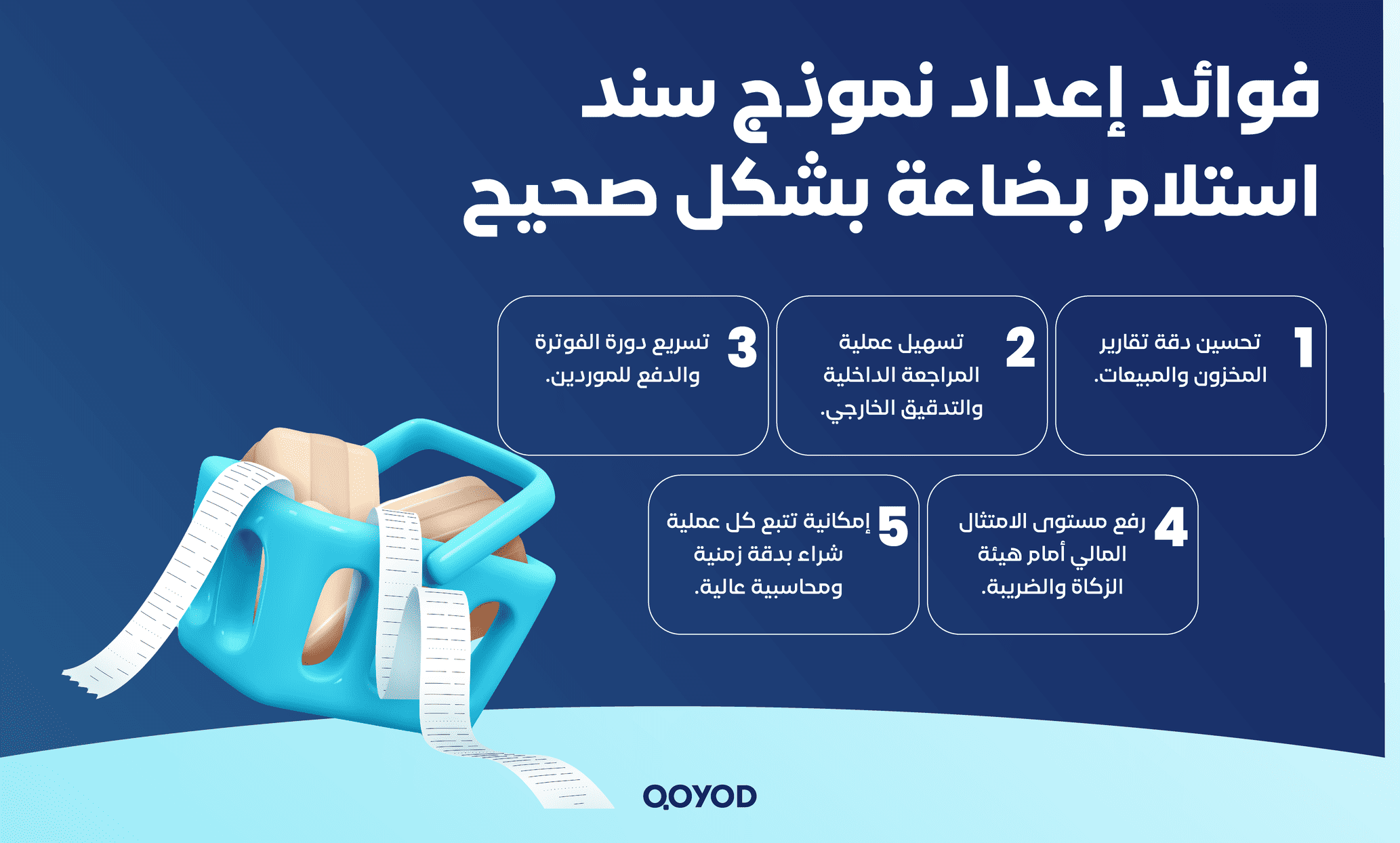
This way, the goods receipt note becomes an indispensable financial control tool for any well-organized business.
Preparing a goods receipt note with precision means establishing a tight financial and inventory system that protects the company from errors and claims and strengthens the trust of suppliers and customers.
The Role of the Goods Receipt Note in Improving Accounting Operations
Integration Between the Goods Receipt Note and the Electronic Invoice
With the digital transformation taking place in Saudi Arabia, linking goods receipt notes with electronic invoices has become an accounting and operational necessity to ensure transparency and compliance with the requirements of the Zakat, Tax and Customs Authority (ZATCA).
When the goods receipt operation is recorded electronically, it makes creating the electronic invoice easier and more automatic based on the approved note data, which reduces human errors and saves accountants’ time.
This process enables companies to:
- Make sure that all received goods have been properly invoiced.
- Monitor the flow of purchases accurately from suppliers into the central accounting system.
- Improve compliance with Saudi regulations on documentation and transparency in commercial transactions.
The electronic goods receipt note is considered a key part of the smart accounting transformation journey, where it is recorded in the system in full integration with invoices, purchase orders, and inventory.
Advantages of Using an Electronic Template Instead of Paper
Moving to electronic templates is no longer a luxury; it has become a standard in modern work environments.
The main advantages of the electronic goods receipt note can be summarized in the following points:
- Time and effort savings: no need for printing or manual archiving.
- Easy search and retrieval: the note can be accessed within seconds through the system.
- Automatic linking with invoices: reduces manual errors and ensures consistency.
- Data protection: through the secure cloud storage provided by systems such as Qoyod.
- Immediate compliance with government regulations: transactions are recorded electronically in line with the requirements of the Zakat, Tax and Customs Authority (ZATCA).
The truth is that inventory management is a vital process for any company that sells products, going far beyond simply storing goods.
It can be defined as the process of planning, directing, and controlling the flow of raw materials, work-in-process goods, and finished products from the point of purchase to the point of sale or consumption.
- You can learn more about: inventory management with the Qoyod accounting software
Download a Ready-to-Use Goods Receipt Note Template
Any company or accountant can now download an official and editable goods receipt note template in PDF and DOCX formats and use it directly in their daily operations.
This template provides a professional structure that includes:
- Supplier and recipient details.
- Goods description and quantities.
- Signatures of both parties and date of receipt.
- Associated invoice or purchase order number.
The goods receipt note is one of the most important documents that no commercial or industrial activity can do without, because it combines accounting accuracy, legal documentation, and operational efficiency.
Thanks to modern digital solutions offered by specialized companies such as Qoyod, it has become easy to manage everything related to receipt notes, invoices, and purchases in a single, integrated, easy-to-use system.
If you are looking for a professional way to manage your business and comply with e-invoicing requirements in Saudi Arabia, Qoyod is your ideal partner for achieving compliance, efficiency, and transparency.
Write a clutter-free professional future and start with Qoyod.
Frequently Asked Questions (FAQ) About the Goods Receipt Note Template
You can now try Qoyod free for a limited time and see all these features for yourself through [the Qoyod app and software link].
You can also follow our pages on Twitter, TikTok, and Instagram to be the first to see the latest articles and updates and get the chance to learn and grow in the world of accounting and finance.