















| Expert Summary: This comprehensive guide breaks down the Saudi Standard Classification of Occupations (SSCO) for businesses operating in Saudi Arabia. Learn how SSCO ensures unified data, supports e-invoicing compliance, and enhances data accuracy when integrated with modern cloud accounting systems like Qoyod. |
The rapidly evolving global business landscape, driven by digital transformation, requires small and medium-sized businesses (SMBs) to maintain highly accurate and compliant internal data. While specific to Saudi Arabia, the Saudi Standard Classification of Occupations (SSCO) represents a universal shift towards mandatory data standardization, a practice critical for accurate payroll, tax reporting, and efficient administrative systems.
This need for unified, precise data is where modern tools like Qoyod Accounting Software become indispensable. SSCO adopted in Saudi Arabia to standardize job descriptions, coding, and professional classifications, ensures regulatory compliance and enhances data quality across government and private sectors. This article explores how adopting a unified classification system, even if country-specific, directly impacts the efficiency and accuracy of your business operations, especially when using a robust cloud accounting system for e-invoicing for businesses and broader financial management.
What is the Saudi Standard Classification of Occupations (SSCO)?
The Saudi Standard Classification of Occupations (SSCO) is an official national system adopted in Saudi Arabia to unify, define, and code job titles and professional designations in a standardized manner, aligning with international criteria.
This system serves as a unified reference point for all public and private entities managing employee records, including:
- The Ministry of Human Resources and Social Development
- Governmental sectors
- Private companies and establishments
- E-invoicing and Human Resources (HR) systems
- Social Insurance agencies
- National Data Centers
The SSCO was developed based on the International Standard Classification of Occupations (ISCO-08) by the International Labour Organization (ILO), adapted to meet the specific needs of the Saudi labor market. This blend achieves:
- The precision of international classification standards.
- Consideration for local occupations common within the Kingdom.
- Ease of use within governmental and administrative systems.
Importance of SSCO in the Labor Market
The SSCO is more than just a list of job titles; it is a vital tool for raising the level of professionalism and administrative transparency in the labor market. Its significance stems from several key aspects:
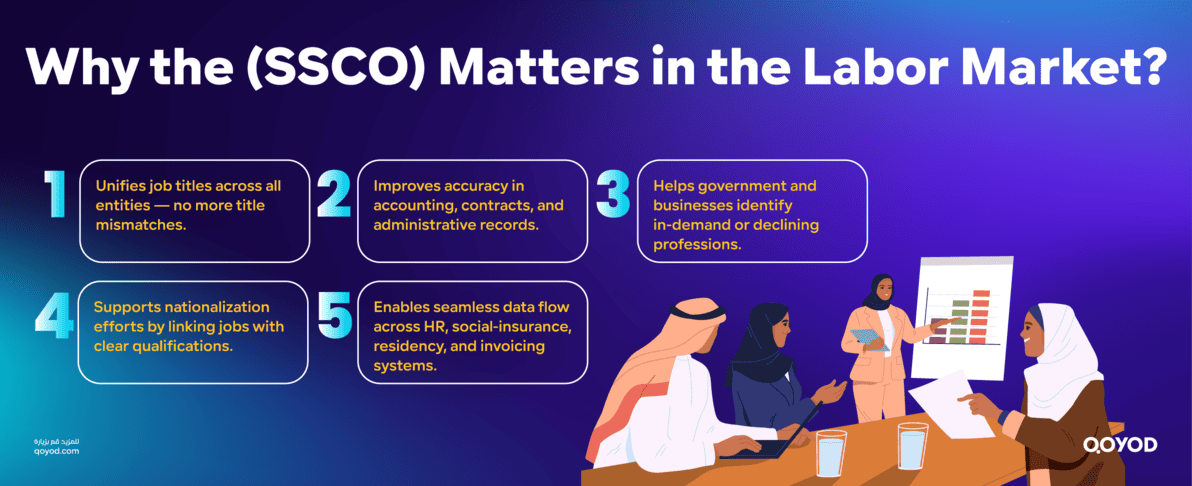
1. Unifying Job Titles Across All Entities
The disparity in job titles was a common issue, leading to data conflicts and inaccurate reports across documents like:
- Invoices (relevant for e-invoicing).
- Contracts.
- Social Insurance records.
- HR management systems.
By adopting the unified title, businesses achieve:
- Standardization of professional language nationwide.
- Facilitation of electronic integration between government entities.
- Improved quality of governmental data related to employees.
2. Ensuring Accuracy of Accounting and Administrative Information
With a standardized classification reference, administrative software, including Qoyod Accounting Software, is empowered to:
- Automatically record and categorize jobs.
- Generate invoices and reports based on certified, classified data.
- Avoid errors resulting from arbitrary or non-standard titles.
3. Supporting Strategic and Governmental Planning
The classification database provides realistic monitoring of:
- In-demand occupations.
- Outdated professions.
- Skills gaps within the workforce.
- Areas experiencing the highest growth in the Kingdom.
This data enables the government to develop future policies related to the labor market, education, and nationalization programs.
4. Enhancing Nationalization (Tawteen) and Quality of Recruitment
Adopting accurate titles means:
- A realistic description of the job’s nature.
- Clear definition of required skills and standards.
- Support for nationalization programs in targeted professions.
Each job in the system is linked to a clear description, qualifications, and tasks, which reduces non-professional or token employment.
5. Streamlining Data Flow Between Government Systems
When a company registers an employee with an approved title, the data flows seamlessly:
- Recognized by the HR system.
- Automatically transferred to Social Insurance.
- Appears consistently in passports/residency systems.
- Linked to invoicing and commercial registration systems without conflict.
The Operational Structure of SSCO
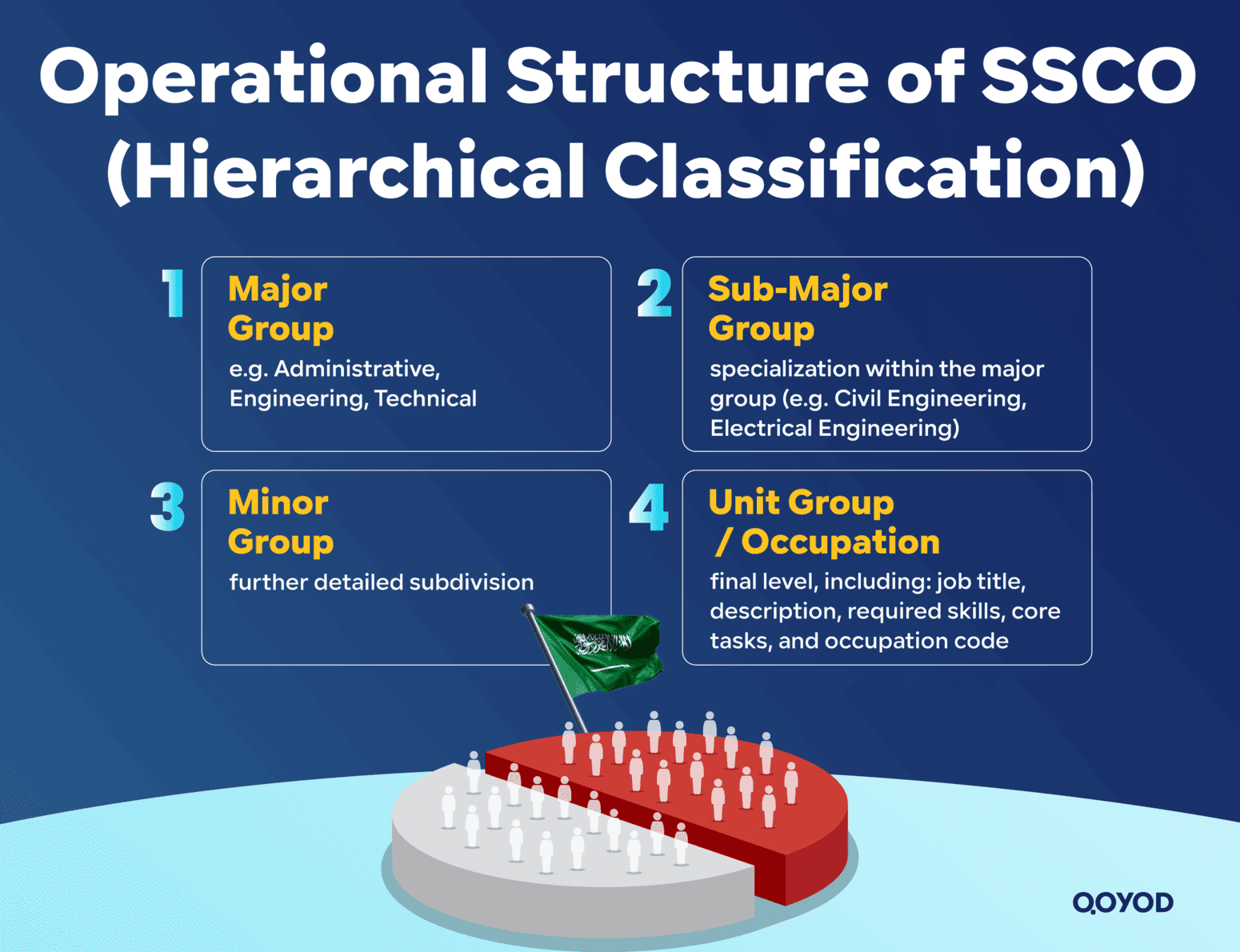
The classification relies on a hierarchical structure that progresses from the broadest professional field to the most specific job title.
This progression includes:
- Major Group: (e.g., Administrative Occupations – Engineering Occupations – Technical Occupations)
- Sub-Major Group: Specialized divisions within the field (e.g., Civil Engineering – Electrical Engineering – Software Engineering)
- Minor Group: A more detailed classification within the specialization.
- Unit Group / Occupation: The final level, containing:
- Job Title
- Brief Description
- Required Skills
- Core Tasks
- Occupation Code
This code is essential for automated recognition by various ministries and systems, including the Ministry of Human Resources, Social Insurance, the General Directorate of Passports, the Ministry of Commerce, and the Zakat, Tax, and Customs Authority (ZATCA) for e-invoicing and work certificates.
This integration makes the SSCO not an option but a fundamental part of the daily operational cycle for businesses.
Benefits of Adopting the Classification for SMBs
For a business owner or HR manager, adopting a system like SSCO provides tangible benefits:
1. Reducing Administrative Errors
Using an unlisted or non-conforming job title can cause issues with:
- Social Insurance registration.
- Residency/Visa processing.
- Official records.
Adopting the unified title removes these complexities, ensuring compliance.
2. Generating Accurate Financial Reports
Standard classifications enable the ability to:
- Measure employee count by specialization.
- Compare departmental structures effectively.
- Study professional skill gaps within the establishment.
3. Enhancing Competency-Based Recruitment
Every SSCO job title is linked to a clear description and specific skills, supporting:
- Selection of qualified staff.
- Performance evaluation.
- Building a fair salary scale.
Practical Application of SSCO in Business Systems
The practical use of SSCO involves integrating the unified job code into official systems like the Ministry of Human Resources, Social Insurance, and especially accounting and e-invoicing platforms.
Searching for Occupations within SSCO
The SSCO provides an online platform for directly searching any occupation to find:
- The official job title.
- The occupation code.
- The corresponding international classification.
- Required tasks and skills.
Available Search Methods
- Search by Job Title: e.g., “Software Engineer,” “Financial Manager,” or “Certified Public Accountant.”
- Search by Code or Number: Each occupation has a unique numerical code for direct lookup.
- Browse by Hierarchical Levels: Useful for companies organizing internal positions according to a professional map.
The Occupation Code in the Classification
Each occupation code is a series of numbers where each digit refers to a specific level within the professional structure.
Example: “2512”
This number represents:
- Major Group Number
- Sub-Major Group Number
- Minor Group Number
- Unit Group Number (Specific Occupation)
Lower numbers indicate a broader classification, while higher numbers denote a more specific specialization.
| Job Title | Occupation Code | Major Group |
| Computer Network Engineer | 2523 | Technical Occupations |
| Financial Manager | 1211 | Management and Finance |
| Accountant | 2411 | Accounting Occupations |
| Marketing Specialist | 2431 | Commercial Occupations |
| Electrician | 7411 | Industrial Occupations |
Using the Occupation in Official Systems
The occupation code is utilized across most governmental services:
- Ministry of Human Resources: For registering and updating employee data.
- Social Insurance: To accurately define the actual occupation and link it to employee subscriptions.
- General Directorate of Passports: For issuing, renewing, and transferring residency permits.
- E-Invoicing System (ZATCA): The occupation helps standardize data for:
- Independent professional service providers.
- Accounting activities.
- Professional services firms.
- Enterprise Resource Planning (ERP) Systems: Such as Qoyod Accounting Software, HR modules, and tax/Zakat systems.
The presence of the SSCO ensures data accuracy within invoices and accounting reports.
SSCO Frequently Asked Questions (FAQ)
Is the SSCO mandatory for all companies?
Yes, using the classification is mandatory when registering jobs, changing an employee's occupation, dealing with Social Insurance and Passports, and inputting data into modern accounting systems. This ensures data standardization and integrated governmental system linkage.
What happens if a company uses a title not found in the classification?
The company may face issues such as:
Rejection of employee registration in the Ministry of Human Resources.
Data inconsistency with Social Insurance.
Difficulties in renewing residency or transferring sponsorship.
Inaccurate tax reporting.
Invoice rejection in the e-invoicing system.
Therefore, only the approved title from the official list must be selected.
Must the title match the nature of the job exactly?
Yes, because every job within the classification is defined by its duties, educational qualifications, and field of specialization. Selecting an inaccurate title can cause problems in skill assessment, Social Insurance subscriptions, and nationalization programs.
Does the SSCO only cover manual and craft occupations?
No, the classification covers all occupations, including: Administrative, Health, Engineering, Technical, Commercial, Craft, Educational, Industrial, Governmental, and Independent Professional jobs. It comprehensively covers the entire labor market.
Do freelancers use the SSCO?
Yes, especially those who issue e-invoices, have a commercial register, or operate in a formal capacity that requires linking their data to government systems. It helps register the work activity professionally and in compliance with official regulations.
In Conclusion:
The push for standardized occupation classification, exemplified by the SSCO, underscores a global trend: the requirement for meticulous data integrity across all business functions. For small and medium-sized businesses, this level of precision is non-negotiable for compliance with e-invoicing mandates and accurate financial reporting. Leveraging an advanced cloud accounting system is the most effective way to manage these complexities.
Try Qoyod Accounting Software now to make your business operations easier and more accurate with solutions designed for modern businesses.