| Expert Summary
This comprehensive guide explains the critical role of a professional Experience Certificate in enhancing global career mobility and business credibility. It provides essential legal frameworks and over 15 free, customizable templates for various roles, highlighting the importance of accurate documentation for SMEs and employees. |
Are you seeking the document that opens the doors to better job opportunities and officially validates your professional journey? An Experience Certificate (or Certificate of Service) is more than just a piece of paper; it’s the professional passport that proves your competency and expertise acquired in a competitive global job market.
This comprehensive guide is dedicated to helping you understand everything related to the Experience Certificate and its universal application. Whether you are an employee seeking to secure your legal right to documentation or a business owner (SME) looking for the best way to issue one, you will find the answers and details here.
Why Your Business and Career Need This Guide
In today’s continuously evolving digital landscape, where processes like accounting automation and e-invoicing are standard, securing a reliable and legally compliant Experience Certificate is crucial. This guide provides globally relevant context on:
- A detailed explanation of the fundamental rights of employees to receive this document.
- A complete guide on the necessary information required for issuing a professional certificate.
- More than 15 specially designed Experience Certificate templates for high-demand global roles, including the Accounting Experience Certificate and other professions.
What is an Certificate of experience?
Also known as a Certificate of Service, this is an official document that confirms an individual has gained practical experience in a specific field during their employment with a particular company. The company issues this certificate to the employee upon the termination of the employment relationship. It is a vital tool used by the employee for various purposes, such as:
- Applying for a new job.
- Obtaining an academic scholarship or grant.
- Immigration or travel purposes.
- Other professional requirements.
Benefits of the Experience Certificate
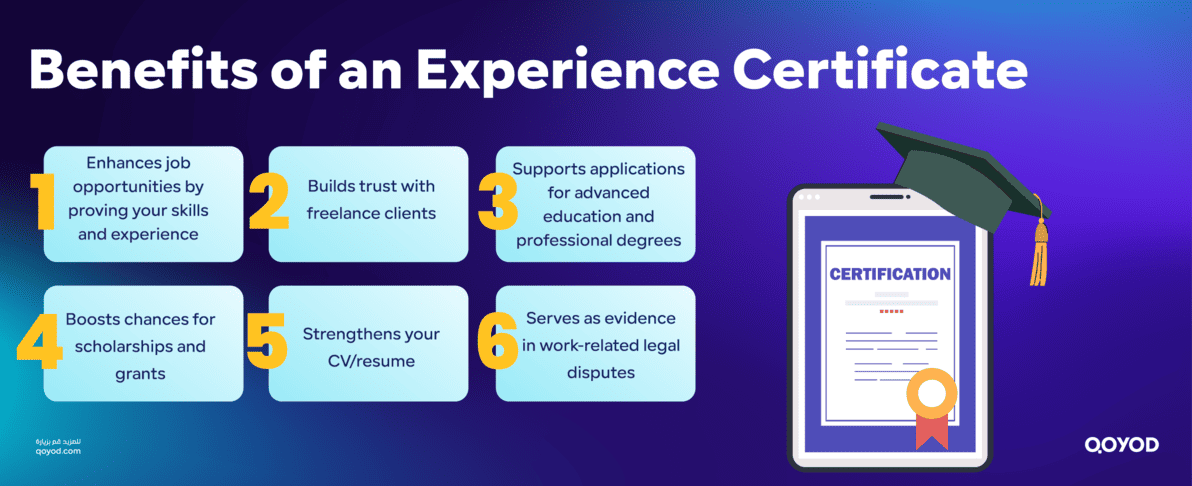
The Experience Certificate is one of the most important professional documents an individual can possess, playing a pivotal role in various aspects of professional life. Here are its key benefits:
Enhancing Job Opportunities
The Experience Certificate serves as formal proof of the employee’s competency and eligibility for a specific role. It instills confidence in potential employers regarding the applicant’s capabilities, increasing the likelihood of securing the desired position.
Transitioning to Freelancing
The freelance economy requires building significant trust with clients, which can be challenging for newcomers. The Experience Certificate is crucial here, as it reinforces client confidence in the freelancer’s abilities and professional skills, making it easier to secure new projects.
Pursuing Advanced Education
Some academic programs, particularly professional Master’s programs, require evidence of practical work experience. Possessing an Experience Certificate validates the individual’s competence and knowledge in their field, enabling enrollment in suitable educational programs for skill and knowledge development.
Scholarship and Grant Applications
Obtaining scholarships is a competitive and difficult process, and professional experience is often a decisive factor in acceptance. Attaching an Experience Certificate to the application significantly increases the chances of approval, demonstrating the applicant’s seriousness and competence.
Strengthening the Resume/CV
The CV is the primary tool used for job applications. Attaching an Experience Certificate enhances the strength of the CV, making it more compelling to potential employers and increasing the chances of landing an interview.
Use in Legal Disputes
The Experience Certificate can be part of the official documentation used to resolve work-related legal disputes. It provides evidence of the individual’s performance and skills and may help in settling cases concerning employment contracts or employee obligations.
Importance of the Experience Certificate for Individuals
The Experience Certificate is a fundamental tool that boosts an individual’s opportunities in several areas:
- When Applying for a Job: Submitting experience certificates from previous workplaces authenticates an individual’s competence and skills, especially when issued by reputable or international companies.
- When Applying for Academic Grants: Many Master’s and PhD scholarships mandate professional experience in the field of study, particularly for professional programs. A documented Experience Certificate proves the required practical experience.
- Accumulating Years of Experience: If an individual has worked for several companies over the years, these certificates help in aggregating and proving their total professional experience.
Importance of the Experience Certificate for Companies (SMEs)
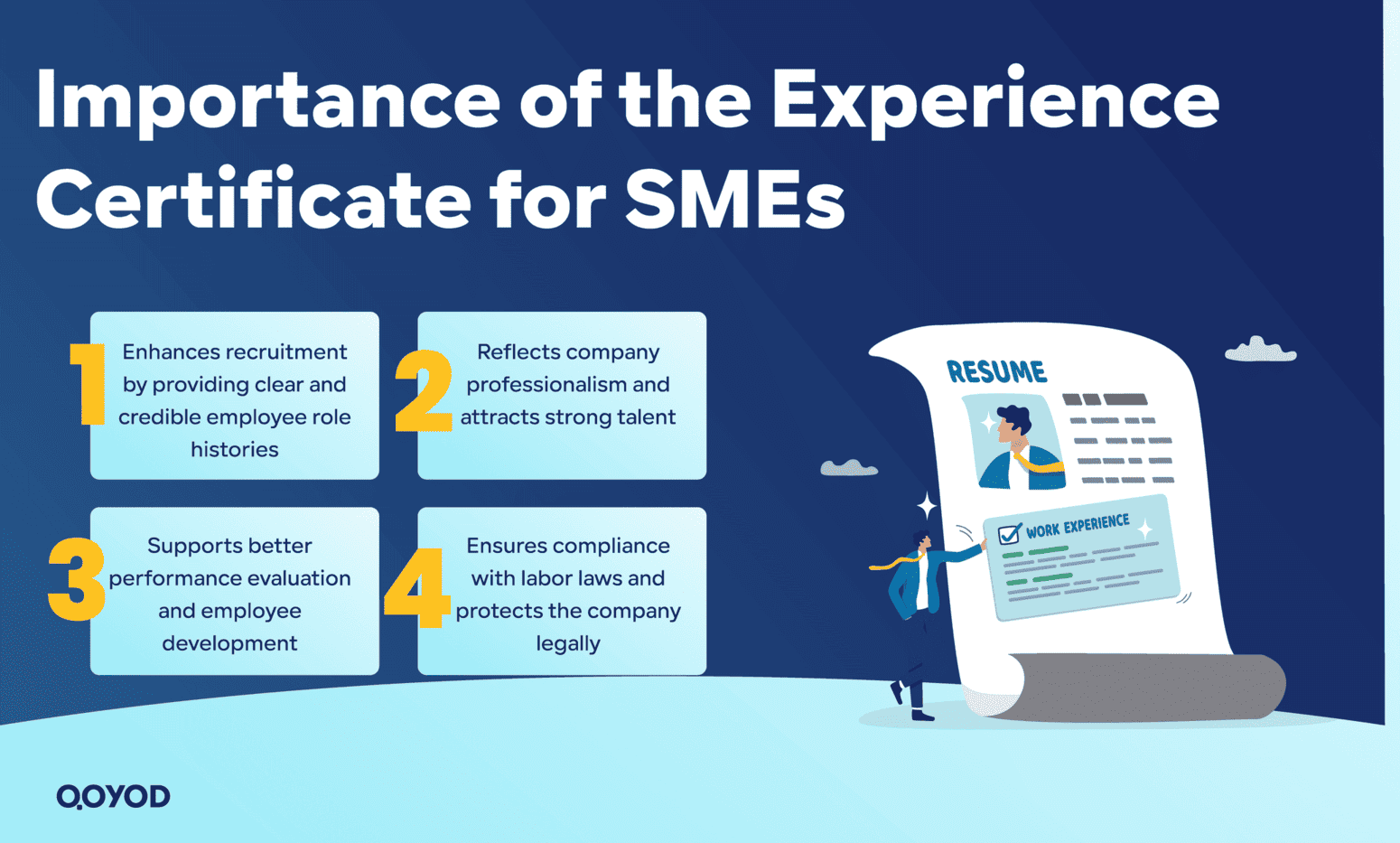
The Experience Certificate is not only beneficial for individuals but also highly valuable for companies, including small and medium-sized businesses (SMEs). This importance can be summarized as follows:
- Enhancing the Recruitment Process: When companies commit to providing their employees with Experience Certificates that include accurate role descriptions and performance evaluations, it becomes easier for other companies to identify and hire suitable talent.
- Demonstrating Company Professionalism: Issuing these certificates is evidence of a company’s professionalism and reliability, increasing its attractiveness to high-caliber and professional personnel.
- Improving Employee Performance: To issue accurate and comprehensive certificates, a company needs a robust performance evaluation system to track employee development regularly. This helps improve overall performance by identifying strengths and weaknesses and providing appropriate support.
- Legal Compliance: Employees have the right to receive their Experience Certificate upon termination of their employment. Providing these certificates is a legal obligation for companies, reflecting the company’s adherence to labor laws and regulations.
What to Include in an Experience Certificate
Writing an Experience Certificate requires adhering to a core set of elements that ensure its necessary credibility and clarity. The most important of these include:
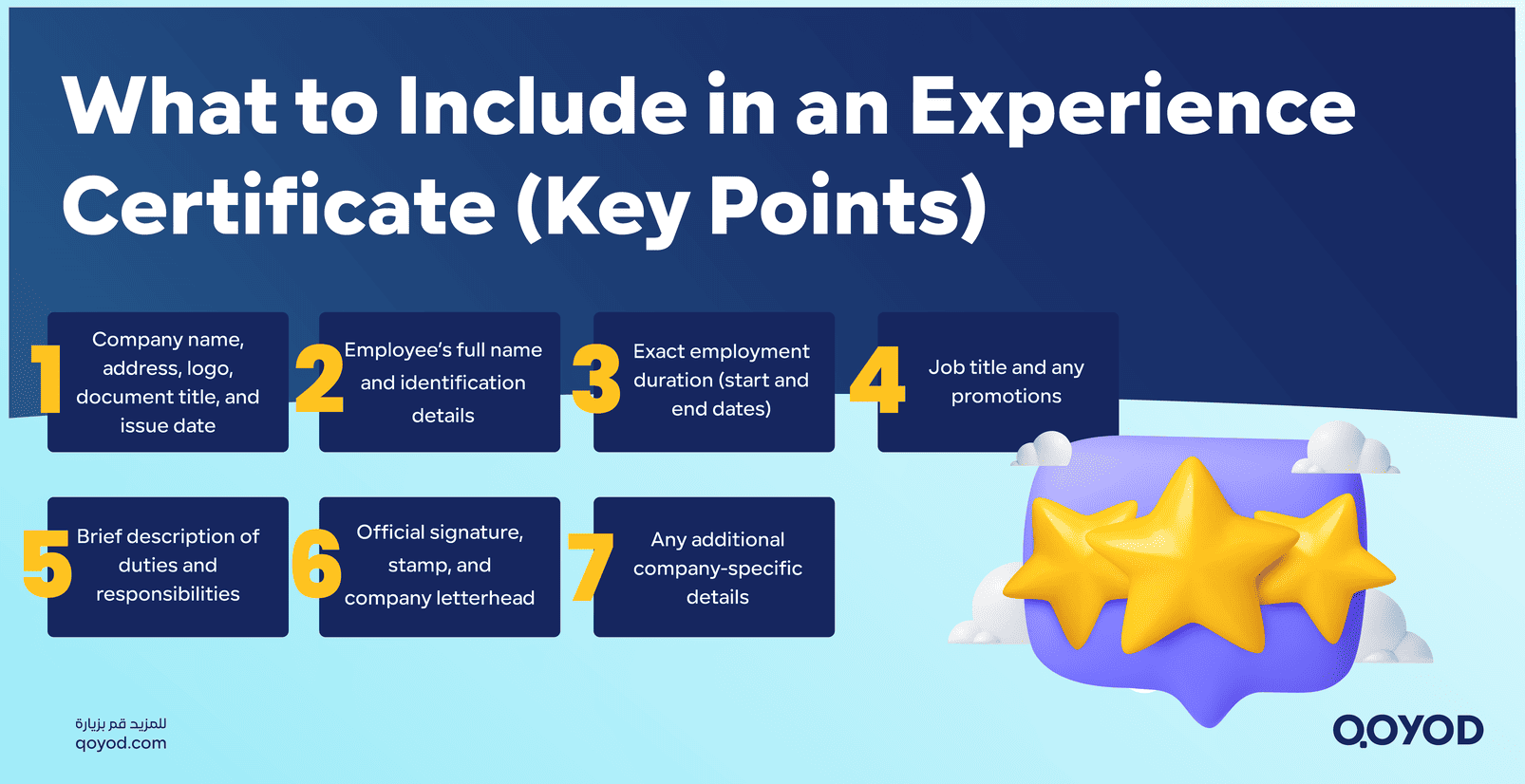
1. Company Identity, Document Title, and Date of Issue
The certificate must start by clearly stating the full company name, its official address, and the company logo (if available). The phrase “Experience Certificate” or “Certificate of Service” should be written clearly at the top, and the date of issue must be included.
2. Employee’s Personal Information
This section includes the employee’s accurate personal data. It is essential to write the employee’s full name, ID/Passport number, and Social Security/Insurance number (if applicable). These details prevent confusion due to similar names and add greater credibility, ensuring the certificate is directed specifically to the concerned individual.
3. Defining the Duration of Experience
The exact number of years the employee spent at the company must be stated, detailing the start date and last day of employment. If the company operates under a parent company or has different trade names, the parent company should be referenced to ensure contextual clarity.
4. Specifying the Job Title
The certificate must mention the job title held by the employee during their tenure, including their professional grade and the highest position they achieved. If the employee transitioned between several positions or received promotions, this should also be clarified.
5. Description of Work Nature
The certificate should include a description of the work performed by the employee, referring to the tasks and duties assigned to them. If the employee held an administrative or leadership position, this should be stated clearly, along with the department or sector they worked in.
6. Signature and Certification of the Certificate
Once complete, the certificate must be printed on company-headed paper bearing the logo and contact information. It must be signed by the responsible managers and authenticated with the official company stamp or the Human Resources Department stamp.
7. Adding Company-Specific Information
Some companies may add extra details or modify the above points according to their vision and nature of activity. This gives the certificate a unique character and aligns with the company’s internal policies.
Uses of the Experience Certificate
The Experience Certificate is a vital document that verifies an employee’s period of service at a specific company. Its importance stems from its use in several key situations:
- Enhancing the CV/Resume: Attaching Experience Certificates to a CV boosts its value and attracts the attention of hiring managers, increasing the chances of securing the job.
- Seeking New Employment: The Experience Certificate is one of the primary documents requested by many companies when applying for a vacant position, used as proof of the applicant’s competence and professional experience.
- Internal Company Promotions: The certificate can assist an employee in obtaining a promotion within their current company by demonstrating the development and competence gained during their employment.
- Freelance Work: At the start of a freelance career, securing client trust can be challenging. The Experience Certificate plays a significant role in building this trust by officially verifying the freelancer’s expertise in their field.
- University Admission and Scholarships: Some academic programs, such as professional diplomas, require practical experience for admission. The Experience Certificate is the optimal means of proving this experience. Additionally, it is used when competing for scholarships, as it is a criterion used by universities or organizations to evaluate applicants.
- Internal Departmental Transfers: The certificate may be used to prove competence and experience when an employee requests a transfer to another department within the same company, enhancing their chances of approval.
- Legal Disputes: Since the Experience Certificate is an official document from the company, it is sometimes used as evidence in legal disputes that may arise between the employee and the company.
- Other Situations: The Experience Certificate is used in any situation that requires proving practical experience in a specific field, making it a valuable and versatile document for individuals across professional and educational sectors.
Ready-to-Use Experience Certificate Templates
Here is a comprehensive set of ready-made and optimized Experience Certificate templates.
Generic Experience Certificate Template
Usage: For general and administrative roles that do not require an in-depth technical assessment.
| To Whom It May Concern
[Company Name] hereby grants this certification of experience to Mr. / Ms. [Employee Full Name]. Mr./Ms. [Employee Name] joined our administrative team as [Job Title]. Throughout their tenure within the organization, they demonstrated significant success and were an exemplary employee in their dedication, commitment, and diligence. They were distinguished by their complete adherence to the duties assigned to them and were a valuable addition to the team in achieving the company’s overall goals. They commenced work with us on [Start Date] and their employment ended on [End Date]. This certificate has been issued on [Day], corresponding to [Date] upon their request and without any liability on the part of the company. Manager Signature: [Manager Signature] Company Stamp: [Company Stamp] |
Accounting Experience Certificate Template
Usage: Specifically for professionals who use accounting software like Qoyod Accounting Software and require detailed verification of financial expertise.
| [Full Company Name/Institution]
Address: [City – Neighborhood Name – P.O. Box] Phone: [Contact Number] Date of Issue: [Day] corresponding to [Date] Subject: Experience Certificate Dear Sir/Madam, We, [Company/Institution Name], are pleased to provide this certificate to confirm that Mr./Ms. [Employee Full Name], holder of ID/Iqama/Passport No. [ID or Passport Number], held the position of [General Accountant / Auditor] with us from [Start Date] to [End Date]. During their employment, Mr./Ms. [Employee Name] demonstrated advanced accounting skills and extensive knowledge in the field of [Specify the area of specialization, e.g., Budget Preparation, Accounting Systems, Tax Compliance]. They were highly efficient in performing their assigned duties, which specifically included: preparing and auditing daily entries (journal entries), financial data analysis, and contributing to the preparation of final financial reports. They showed great diligence and commitment to completing work accurately and on time. We issue this certificate at the request of Mr./Ms. [Employee Name], and the company bears no legal responsibility resulting from its future use by him/her. We wish him/her all the best and success in their future professional career. Signature of the Competent Manager: [Manager Signature] Manager Name: [Responsible Manager Name] Position: [Manager Position, e.g., General Manager / Human Resources Manager] Company Stamp: [Place for the Stamp] |
Download Ready-to-Edit Global Experience Certificate Templates
Here is a comprehensive set of Experience Certificate templates, prepared and optimized for global professional standards.
To download our reliable and editable templates directly:
- [Blank Experience Certificate Template]: [Download Link]
- [Administrative Roles Experience Certificate]: [Download Link]
- [Civil Engineer Experience Certificate]: [Download Link]
- [Teacher/Academic Experience Certificate]: [Download Link]
- [Sales Employee Experience Certificate]: [Download Link]
- [Customer Service Experience Certificate]: [Download Link]
- [Administrator / Executive Secretary Experience Certificate]: [Download Link]
- [Information Technology (IT) Experience Certificate]: [Download Link]
- [Human Resources (HR) Experience Certificate]: [Download Link]
- [Maintenance Technician / Craftsman Experience Certificate]: [Download Link]
- [Digital Marketing Experience Certificate]: [Download Link]
[Banking / Financial Employee Experience Certificate]: [Download Link]
Legal Framework and Employee Rights: The Global Perspective
To obtain any official document, one must refer to the legislative framework. This section clarifies the essential legal details you should know, referencing universal principles common in international labor laws.
A. The Fundamental Right to an Experience Certificate
While specific laws vary by country, the principle that an employee is entitled to a service certificate upon termination is a widely recognized right in international labor practice, often stipulated in national labor codes. For example, similar provisions are found in many jurisdictions, asserting:
“The employer is obligated, upon termination of the employment contract, to provide the worker,if requested a Certificate of Service free of charge, specifying the date of joining, the date of termination, the type of work performed, and the wages received. If the certificate contains anything that may harm the worker’s reputation or reduce their employment opportunities, they shall be entitled to request its modification or cancellation.”
Key Importance of this Principle:
- Inherent Right: The employer cannot refuse your request for an Experience Certificate or Certificate of Service.
- Free Issuance: The certificate must be issued without any cost to the employee.
- Reputation Protection: The worker’s rights are protected even in the content of the certificate, granting the right to object to any phrase that harms their professional reputation.
B. When Can You Request the Certificate? (Termination Cases)
The certificate is tied to the conclusion of the contractual relationship. You are entitled to request the Experience Certificate regardless of whether the contract ended by:
- Resignation or expiration of the agreed term (for fixed-term contracts).
- Termination by the employer (with or without just cause).
- Retirement.
Important Note: Even in cases of contract termination without just cause, the employee’s rights are not forfeited. The Experience Certificate becomes even more crucial to document their periods of employment.
Experience Certificate vs. Certificate of Service: Key Differences
| Point of Comparison | Certificate of Service (Work Certificate) | Experience Certificate |
| Primary Goal | Documentation of the time period only. The goal is to prove the existence of a prior employment relationship. | Performance and competency evaluation. The goal is to highlight skills, achievements, and the nature of completed tasks. |
| Core Content | Abstract basic data: start date, end date, job title, and basic wage. | In addition to basic elements: includes an assessment of the employee’s performance, a detailed description of key tasks and achievements, and a statement of the level of professionalism and skills acquired. |
| Legal Obligation | Mandatory upon request. The employer is legally obligated to provide it (if requested by the employee). | Not mandatory regarding the performance assessment. The law does not compel the employer to add a performance review, but it is typically requested to enhance the employee’s opportunities. |
| Impact on Hiring | Less impactful; it proves you worked. | High impact; used as a tool for comparison and acceptance for new jobs or immigration, as it provides a comprehensive view of your competence. |
| Common Requesting Party | Government agencies, proof of insurance period, or simple procedural requirements. | Large private companies, postgraduate programs (Master’s/PhD), or when applying for jobs requiring high-level expertise. |
Practical Tips for Writing a Professional Experience Certificate
Writing an Experience Certificate is a precise process that requires attention to detail. Here are some tips to help you write a professional certificate:
1. Start with Essential Information
Ensure the certificate includes essential information such as the employee’s name, job title, and dates of employment. These elements guarantee the certificate is accurate and recognized.
2. Be Specific in Describing Tasks and Achievements
Try to be specific when mentioning responsibilities and achievements. For instance, instead of saying, “The employee was responsible for daily tasks,” state: “The employee was responsible for managing a team of 5 employees and coordinating projects for 6 months.”
3. Use Professional Language
Use formal and professional language. Avoid colloquial or vague words. Ensure the text is clear and easy to understand.
4. Emphasize Positive Evaluation
When writing the evaluation, rely on factual and positive observations. Use phrases like, “The employee demonstrated high commitment,” or “They excelled in performing their job duties.”
5. Proofreading and Spell Check
Ensure the certificate is free of linguistic and spelling errors, as errors can affect its credibility.
Common Mistakes to Avoid:
- Excessive Details: Avoid including unnecessary information that might confuse the reader.
- Over-Complimenting: Try to balance providing a positive evaluation with reality.
- Omitting the Manager’s Signature: Don’t forget that the certificate must bear the signature of the direct or responsible manager.
Note: The certificate highlights important details such as the name of the institution(s) the person worked for, the period of employment, and the positions held. This procedure is beneficial for several purposes, such as submitting it to new employers or for other official purposes that require proof of work experience.
How to Benefit from Qoyod Accounting Software When Creating an Experience Certificate
Qoyod Accounting Software is a leading system that offers comprehensive HR management solutions for small and medium-sized businesses (SMEs). It features a range of benefits that significantly contribute to improving and facilitating the process of issuing Experience Certificates for employees. Here’s a look at how to benefit from the software in this regard:
- Tracking Employee Performance and Roles: Qoyod Accounting Software allows you to accurately evaluate employee performance, which helps in preparing an Experience Certificate that truly reflects the employee’s role and contributions.
- Attaching Documents and Images to Employee Files: It provides a feature to attach documents and images within employee files, allowing issued certificates to be stored in an organized and easily retrievable manner.
- Saving Time and Effort (Accounting Automation): Thanks to the integrated system offered by Qoyod, the process of issuing Experience Certificates becomes faster and less complicated, supporting overall accounting automation.
- Accuracy and Professionalism: Qoyod helps you prepare an accurate certificate, as it relies on specific and clear data collected over the employee’s period of employment.
- Easy Access and Sharing (Cloud Accounting System): Due to the cloud storage capabilities of the program, Experience Certificates can be accessed from anywhere, at any time, simplifying sharing with the former employee or potential employers.
Frequently Asked Questions (FAQ) about the Experience Certificate
What is an Experience Certificate?
An Experience Certificate is an official document that confirms an individual worked for a specific company for a determined period, outlining their skills and practical experience gained during that time.
What is the difference between an Experience Certificate and a Certificate of Service?
The terms are often used interchangeably, but a Certificate of Service may sometimes be limited to confirming the period of employment without additional details about skills and achievements. The Experience Certificate generally includes more detail on performance and duties.
Is the Experience Certificate mandatory upon leaving employment?
No, but it is an acquired right of the employee if requested, and the company must issue it according to the labor regulations in effect in the country.
What are the essential elements of an Experience Certificate?
Employee's full name.
Job title.
Duration of employment (start and end date).
A brief summary of tasks and achievements.
Signature and official stamp of the issuing entity.
Can an Experience Certificate be used for academic purposes?
Yes, some academic programs or scholarships require the submission of an Experience Certificate as proof of professional competence.
How can I verify the authenticity of an Experience Certificate?
You can verify the certificate by:
Contacting the issuing company (HR or relevant department).
Ensuring the presence of an official signature and stamp on the certificate.
Is there a specific format for writing an Experience Certificate?
There is no single standardized format, but it is recommended to adhere to the basic standards, such as mentioning important details and including the official signature.
Can an Experience Certificate improve employment opportunities?
Yes, the Experience Certificate is considered a document that enhances opportunities for securing a new job, as it reflects the employee's competence and previous experience.
Are there fees for obtaining an Experience Certificate?
In most cases, the Experience Certificate is issued free of charge by the company, though some companies might impose symbolic administrative fees.
How can I request an Experience Certificate from my current employer?
Submit a formal written request to the Human Resources department.
Clarify the purpose of the certificate (if required).
Ensure you provide the company with the necessary information to prepare the certificate.
Conclusion
The paramount importance of possessing an Experience Certificate in enhancing our professional careers and opening new horizons cannot be denied. It is not merely an official document but a bridge connecting our past experiences with future ambitions, and a living testament to our competence and ability to achieve. We must ensure we obtain it and present it in a way that truly reflects our skills and dedication to work. Remember that possessing distinguished Experience Certificates can be the factor that grants us the opportunity to achieve our professional goals and move toward a bright future.
After learning what to write in any Experience Certificate, Try Qoyod Accounting Software now to make your business operations easier and more accurate with solutions designed for modern businesses.