| Expert
Navigate the complexities of Saudi Income Tax for foreign investors and non-resident businesses operating in the Kingdom. This comprehensive guide details the tax base, rates, exemptions, and compliance requirements for global small and medium-sized enterprises (SMEs). |
In light of the significant economic transformations occurring globally, discussions surrounding Income Tax in Saudi Arabia have captured the attention of many international businesses. While the idea of taxation can seem daunting, it remains a fundamental tool for reinforcing the economy and supporting national development.
What exactly is Saudi Income Tax, and how is it calculated? This article provides a clear, simple breakdown of this evolving tax system and its calculation methods. This clarity is vital for optimal financial planning. For small and medium-sized businesses (SMEs) and foreign investors, understanding tax obligations is paramount to successful operation and compliance, especially with the rise of digital tools for accounting automation and e-invoicing.
What is Income Tax in Saudi Arabia?
Saudi Income Tax is a direct tax levied on income earned by certain individuals and companies. Importantly, this tax does not apply to Saudi citizens. Instead, it targets non-GCC foreign residents and foreign companies generating profits from activities within the Kingdom.
Furthermore, specific activities related to natural resources, such as the oil and hydrocarbon sector, are subject to different tax rates depending on the investment size and economic activity.
Income Tax within the Kingdom
The leadership in Saudi Arabia has affirmed the commitment to not impose Income Tax on Saudi citizens and has indicated a future direction toward lowering the current Value Added Tax (VAT) rate. However, the question for global businesses remains: when and how does a non-Saudi individual or foreign-owned entity become liable for Income Tax on their economic activity in the Kingdom? This is detailed in the following sections.
Defining Taxable Income in the Kingdom
Taxable income includes all revenues, profits, and gains realized by individuals or companies, regardless of the activity’s nature or how the revenue was generated, including capital gains and unexpected returns.
Income is only subject to tax after allowable expenses are deducted to arrive at the net profit. These deductions and exemptions ensure the tax is applied fairly to the true economic gain.
Allowable Deductions from Gross Revenue:
- Costs of goods sold/purchases (before tax calculation).
- Employee salaries and benefits.
- Operational and marketing expenses.
Types of Income Exempt from Saudi Income Tax
The system’s design is a significant factor in attracting foreign direct investment (FDI), as it focuses the tax burden primarily on foreign entities while exempting Saudi citizens. This approach encourages local investment and entrepreneurship among citizens.
The Kingdom currently applies higher tax rates specifically to the petroleum sector to diversify the economy and reduce reliance on oil revenue as the main income source, in line with global economic trends.
Specific Tax Exemptions for Taxable Companies:
Certain types of income are exempt from Income Tax for foreign-owned, taxable companies:
- Profits resulting from the sale of properties not directly linked to the company’s commercial activity.
- Gains from the sale of certain current assets, including financial securities (stocks, bonds) traded on a financial market, both inside and outside the Kingdom.
- Distributions of profits (dividends) to shareholders, provided the company’s contribution to the capital is at least 10% and has been held for a full year.
These exemptions aim to stimulate investments and protect certain types of income that contribute to economic growth without negatively impacting the overall tax system.
How to Calculate Saudi Income Tax
To calculate Saudi Income Tax, you must first accurately determine the tax category your entity falls under and the applicable percentage rate. The calculation then follows a simple process:
- Determine your Annual Net Profit (Taxable Base).
- Apply the corresponding tax rate to the Net Profit.
Calculation Example
If a foreign investor’s entity has an Annual Net Profit (Taxable Base) of SAR 400 million, and the standard tax rate for foreign investors is 20%, the due Income Tax would be:
SAR 400 million × 20% = SAR 80 million
Tax Rates and Values for Residents and Companies
Income Tax rates in Saudi Arabia vary based on the nature of the business and the status of the person or company.
Standard Tax Rates (20%)
The following individuals and entities are subject to a 20% Income Tax on their adjusted net profit:
- Non-resident individuals with a Permanent Establishment (PE) in the Kingdom.
- Companies whose capital is composed of shares.
- Non-Saudi resident individuals carrying out an activity within the Kingdom.
- Institutions operating in the gas investment sector.
Tax Calculation: The Easiest Way to Calculate All Types of Taxes for Saudi Businesses
Oil and Hydrocarbon Sector Tax Rates
Companies engaged in the production of oil and hydrocarbons are subject to significantly higher, varying rates:
| Investment Threshold | Income Tax Rate |
| Investments exceed SAR 375 Billion | 50% |
| Investments between SAR 300 – 375 Billion | 65% |
| Investments between SAR 225 – 300 Billion | 75% |
| Investments below SAR 225 Billion | 85% |
Note: Local companies are subject to Zakat (an Islamic levy) at 2.5% of their net profit, which is separate from the Income Tax system applied to foreign entities.
In a move to attract global talent and headquarters, the Kingdom announced in February 2024 an exemption of foreign companies’ Regional Headquarters (RHQs) from Income Tax for 30 years, with the possibility of renewal.
Rules and Conditions for Income Tax Liability
After understanding the calculation, it is crucial to know the conditions under which income is considered “sourced” in the Kingdom and thus subject to tax. These conditions mainly relate to the origin of the income:
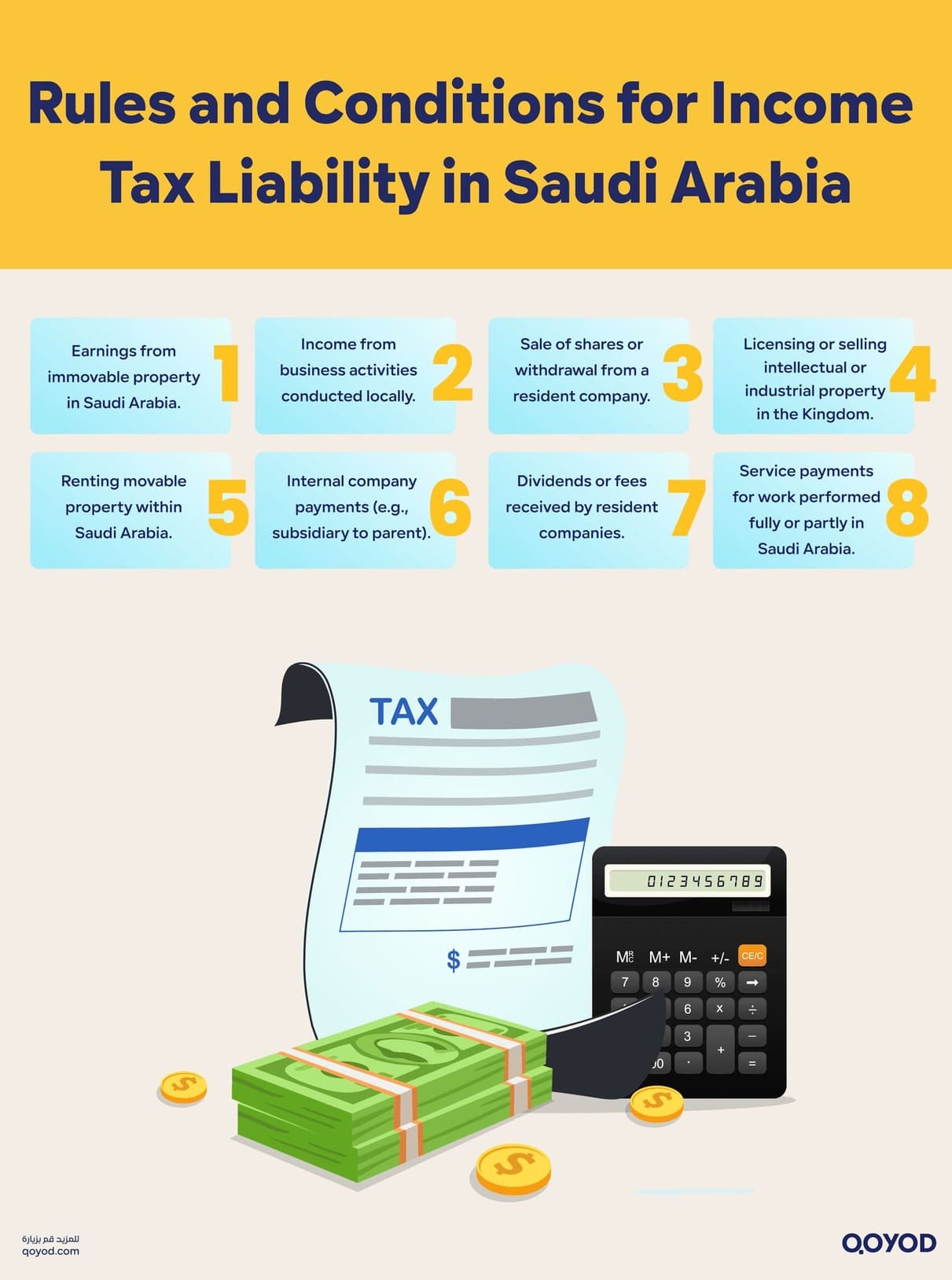
- Income derived from immovable property located in Saudi Arabia.
- Income from an activity or business conducted within the Kingdom.
- Selling shares or withdrawing from a partnership in a resident company.
- Selling or licensing the use of intellectual or industrial property rights in Saudi Arabia.
- Renting movable property within the Kingdom.
- Amounts paid as a result of internal transactions between companies (e.g., payments from a subsidiary to a parent company).
- Profits resulting from shares or fees received by resident companies.
- Amounts paid by a resident for services performed wholly or partly in Saudi Arabia.
Zakat vs. Income Tax in Saudi Arabia
The distinction between the two levies is fundamental for businesses operating in the Kingdom:
| Point of Difference | Income Tax in Saudi Arabia | Value Added Tax (VAT) | Zakat (Islamic Levy) |
| Concept | Direct tax on the financial income/annual profits of foreign entities. | Indirect tax on the sale of most goods and services. | Direct levy on the wealth/net profit of Saudi/GCC citizens and their shares in companies. |
| Rate | Variable rates (e.g., 20%, 50%-85%) depending on entity/sector. | Fixed rate (currently 15%) on supply of goods/services. | Fixed rate of 2.5% on the Zakat base. |
| Applicability | Foreign companies, non-Saudi residents carrying out business, and gas/oil sectors. | Applied across all production and business sectors at the point of sale. | Applied to Saudi/GCC individuals and their portion of local company ownership. |
| Type | Direct tax paid by the company/individual to the tax authority. | Indirect tax borne by the final consumer through the price. | Direct levy on net wealth/profit of the taxpayer. |
Compliance and Penalties for Income Tax
For global SMEs operating in the Kingdom, timely registration and submission of tax returns are mandatory to avoid significant penalties.
How to Register for Income Tax
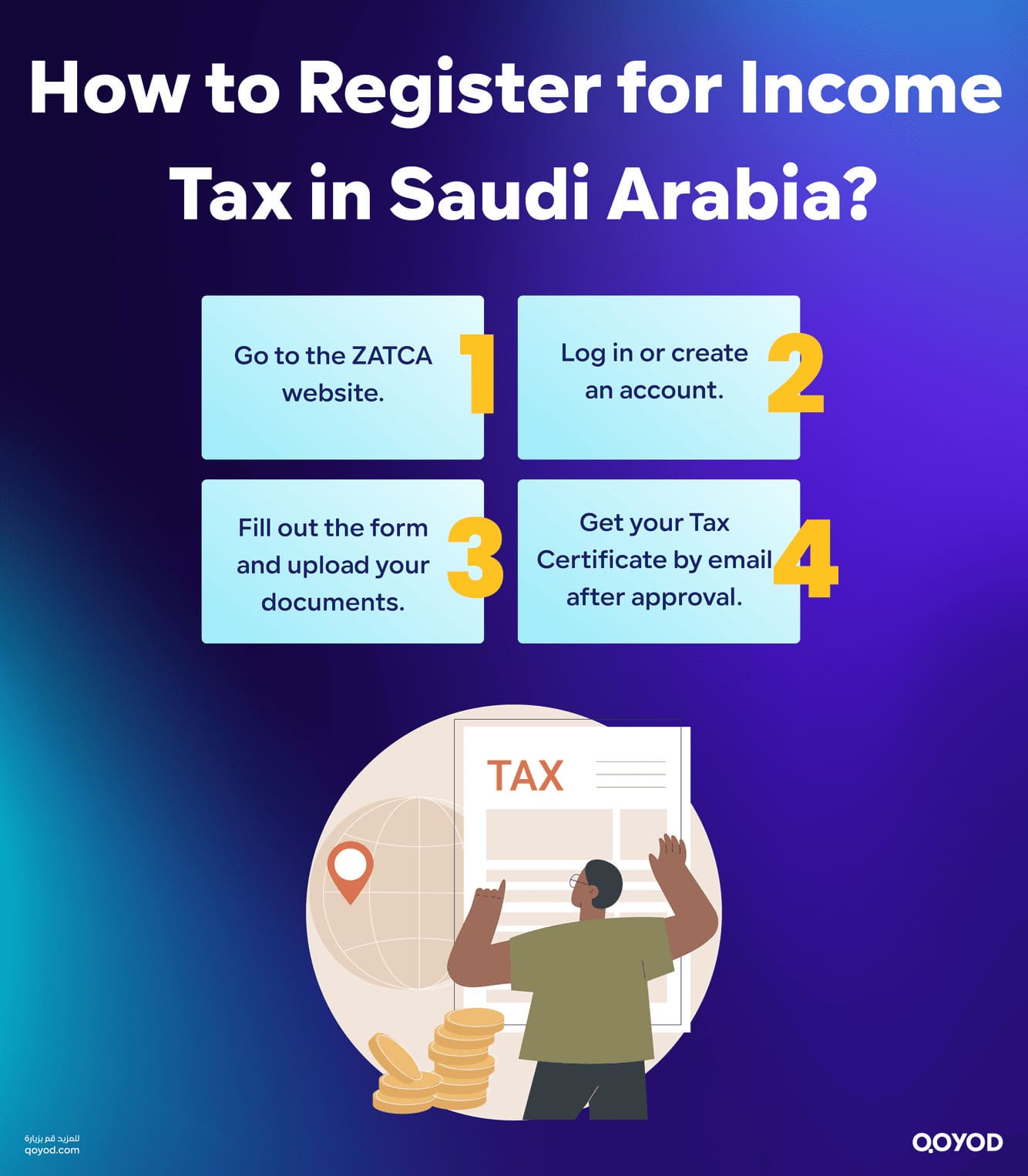
- Visit the official website of the Zakat, Tax, and Customs Authority (ZATCA).
- Log in and start the tax registration process.
- Fill in the required data and attach all necessary documentation.
- Upon review and approval by ZATCA, you will receive your Tax Certificate and transaction number via email.
How to Submit the Income Tax Return
- Log in to the ZATCA electronic portal.
- Select the “Declarations” option, then choose the “Income Tax Declaration”.
- Fill out the declaration with all financial information related to the establishment and submit it.
- You will receive a notification of the invoice amount via SMS and email.
Penalties for Non-Compliance
In Saudi Arabia, penalties are imposed for non-registration, late filing, delayed payment, or manipulating financial data:
- Late Payment: The fine ranges from 5% to 25% of the tax due, increasing with the duration of the delay.
- Data Manipulation/Underreporting: A fixed fine of 25% of the actual difference in the tax value is imposed.
- Late Filing: A fine equivalent to 1% of the tax due for every thirty days of delay, up to a maximum of 25% of the tax amount due.
The Importance of Using Qoyod Accounting Software
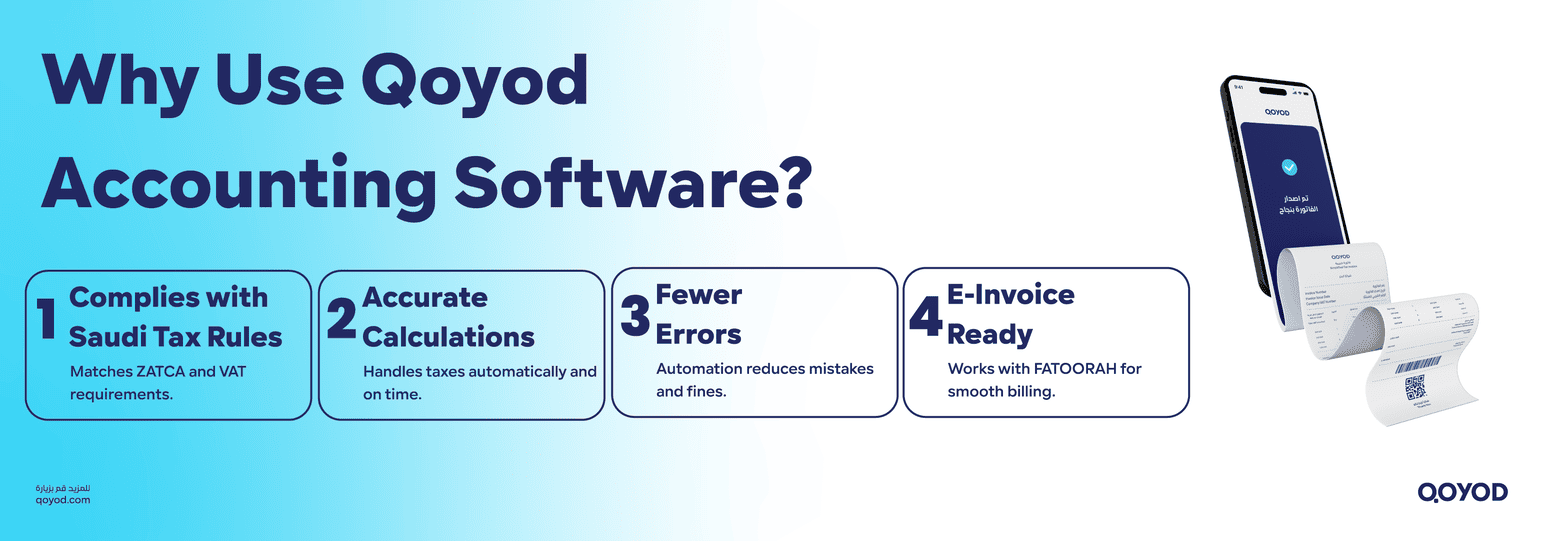
For foreign-owned small and medium-sized businesses (SMEs) managing their operations in the Kingdom, utilizing a compliant and automated system like Qoyod Accounting Software is vital for accurate tax management and reducing compliance risk.
1. Compliance with Tax Regulations
Qoyod provides solutions that comply with Saudi accounting laws, including both Income Tax and VAT regulations. It assists in preparing the required tax reports and ensures adherence to ZATCA guidelines.
2. Accurate Tax Management
The software offers built-in tools for the precise management of Saudi Income Tax and other taxes. This simplifies the accurate calculation of the tax base, facilitates timely tax reporting, and reduces the likelihood of costly errors.
3. Reduction of Accounting Errors
Qoyod automates many accounting processes, significantly reducing the potential for human error in tax calculations and report generation. This automation helps mitigate risks associated with fines and penalties.
4. Integration with E-Invoicing Systems
With the introduction of mandatory e-invoicing in Saudi Arabia, Qoyod integrates with electronic invoicing systems (FATOORAH) to ensure compliance with new requirements, improving the documentation of sales and billing processes.
The Economic Impact of Income Tax under Vision 2030
Income Tax is one of the financial instruments contributing to the goals of Saudi Vision 2030, which seeks to diversify income sources and reduce dependence on oil.
- 1. Boosting Government Revenue: Income Tax provides a sustainable revenue stream, used to fund major development projects (e.g., NEOM) and enhance public services (education, healthcare).
- 2. Attracting Foreign Investment: A clear and transparent tax system, even if a tax is levied on foreign entities, builds confidence among international investors, contributing to FDI and sustainable economic growth.
- 3. Supporting Fiscal Sustainability: Reducing reliance on fluctuating oil revenues through diverse taxes enhances the Saudi economy’s stability and resilience, supporting Vision 2030’s goal of building a flexible, diversified economy.
- 4. Enhancing Economic Efficiency: Taxation encourages businesses to optimize operational efficiency and reduce waste to lower their taxable base, thus improving overall economic performance.
In summary, Income Tax is a central step towards achieving Vision 2030′s goals, supporting economic diversity, financial sustainability, and global competitiveness.
FAQ Section: Top 10 Questions on Saudi Income Tax
What is the core difference between "Zakat" and "Income Tax" in Saudi Arabia?
Zakat (2.5%) is levied on Saudi/GCC citizens and their corporate shares. Income Tax (e.g., 20%) is levied on foreign companies, non-Saudi resident individuals running a business, and specific sectors like gas and oil.
Who is primarily subject to Income Tax in the Kingdom?
The main subjects are resident companies with foreign shareholders (non-Saudi, non-GCC), non-Saudi resident individuals practicing an economic activity, and companies operating in the gas, oil, and hydrocarbon sectors.
What is the standard corporate Income Tax rate for foreign entities?
The basic rate on the taxable base for resident companies owned by foreigners is 20% of the adjusted net profit. Rates can rise significantly, up to 85%, in the oil sector.
Are Saudi citizens subject to Income Tax on their business income?
No. Saudi citizens are subject to Zakat (2.5% of the Zakat base) on their income and business ownership, not Income Tax. Income Tax applies only to the foreign portion of mixed-ownership companies.
What is the definition of a "Resident Person" for tax purposes?
A natural person is considered resident if they have a permanent dwelling in the Kingdom or if they spend a period of at least 90 days in the Kingdom during the tax year.
What types of income are considered "sourced in the Kingdom"?
Income sourced in the Kingdom includes income from any commercial, industrial, or professional activity conducted there, income from selling or licensing intellectual property used in the Kingdom, dividends, and payments for services fully or partially performed within the Kingdom.
What is the deadline for filing the Income Tax return?
The annual tax return must be filed within 120 days after the end of the taxpayer's financial tax year.
What is the penalty for late filing of the Income Tax return?
A late filing penalty equivalent to 1% of the tax due is imposed for every 30 days of delay after the due date, up to a maximum of 25% of the tax amount due.
What are the penalties for manipulating Income Tax data?
A fine of up to 25% of the tax difference is imposed if the taxpayer submits incorrect information to understate the tax due, in addition to potential criminal penalties for evasion.
Are expenses deductible when calculating the Income Tax base?
Yes, the taxable base is calculated after deducting acceptable, permissible expenses that are related to generating the taxable income.
Conclusion: Transform Your Financial Future
What is the impact of Income Tax on your business’s financial future? It is clear that Income Tax in Saudi Arabia is not just a financial obligation but a key mechanism supporting national economic development and sustainable growth under Vision 2030. For international small and medium-sized businesses, adapting to and complying with this system is a necessity for successful operation.
Try Qoyod Accounting Software now to make your business operations easier and more accurate with solutions designed for modern businesses.
Qoyod is a leading cloud accounting system that offers all-in-one solutions, including e-invoicing systems, Point of Sale (POS), inventory, and customer management tools.
Try Qoyod for free for 14 days and take the essential step toward simplifying all your daily financial affairs.