















| (Excerpt) :
A comprehensive guide from Junior Accountant to Chief Financial Officer (CFO), focusing on digital skills and the requirements of e-invoicing and ZATCA. |
The Accountants’ Career Progression in Saudi Arabia is one of the most stable and evolving professional paths, given the vital role accounting plays in supporting the growth of small and medium-sized businesses (SMEs) and large enterprises. With the ongoing digital transformation in business management, and the mandatory requirements of the e-invoicing system in Saudi Arabia and approved accounting systems by the Zakat, Tax and Customs Authority (ZATCA), the demand for qualified accountants is increasing daily.
The fundamental question remains: How does an accountant start their career? And what are the stages they must pass through to reach the pinnacle of the financial hierarchy as an Executive Financial Manager or Chief Financial Officer (CFO)?
In this article, we detail the professional path for an accountant in Saudi Arabia, from the first steps after graduation, through mid-level roles, to senior executive positions, outlining the required skills for each stage and the best tips for rapid promotion in the Saudi work environment.
What is Accountants’ Career Progression?
Defining Career Progression and Its Importance in the Saudi Work Environment
It’s the sequential path of roles and responsibilities an accountant progresses through during their professional journey. This path typically begins with operational roles (like Junior Accountant) and culminates in strategic and leadership positions (like Chief Financial Officer).
In the dynamic Saudi work environment, progression is more than just a promotion. It signifies the accountant’s ability to adapt to rapid changes in financial regulations. This path is crucial for ensuring compliance with local systems, such as the requirements of the Zakat, Tax and Customs Authority (ZATCA) and the evolving e-invoicing system in Saudi Arabia.
How Does the Career Path Differ in SMEs Compared to Large Corporations?
The shape of Accountants’ Career Progression varies significantly based on the size of the establishment:
- Small and Medium-sized Businesses (SMEs): Progression is generally quicker and more flexible. The accountant often acts as a “General Accountant,” covering all functions. They might move from a junior role to Chief Accountant within a few years. Qoyod Accounting Software is the best accounting software in Saudi Arabia for these SMEs.
- Large Corporations and Government Institutions: The path is longer and more specialized. Progression is systematic, requiring specific years of experience and certifications for each promotion. An accountant might work for years in a narrow specialty (e.g., Internal Audit or Cost Accounting) before promotion in major business centers like Riyadh or Jeddah.
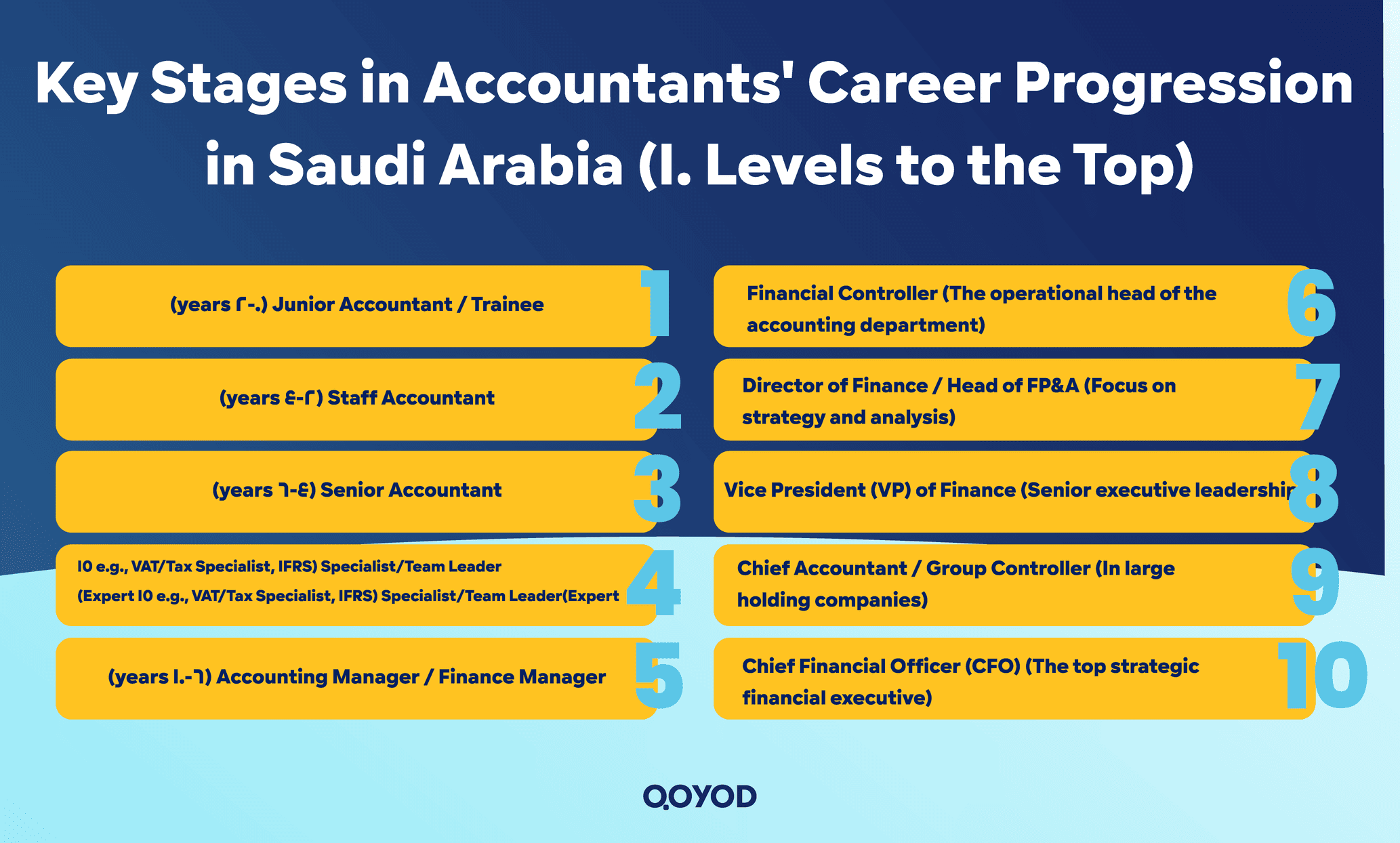
Key Stages in Accountants’ Career Progression in Saudi Arabia (10 Levels to the Top)
Reaching the position of Chief Financial Officer (CFO) involves a series of methodological stages that require acquiring advanced managerial and technical skills. This sequential path focuses on transforming the accountant from a transaction recorder to a decision-maker.
Stage 1: Junior Accountant
This is where the Accountants’ Career Progression journey begins. This role is the foundation for learning the basics of daily accounting work.
- Core Tasks: Entering daily journal entries into the accounting system, matching invoices, preparing payment and receipt vouchers, and document archiving.
- Saudi Requirements: Familiarity with e-invoicing requirements (Fatoorah) and the ability to use cloud accounting software like Qoyod Accounting Software.
- Qualifications: Bachelor’s degree in Accounting, basic Excel skills.
Stage 2: Senior Accountant
The accountant’s responsibility at this stage begins to delve into less routine operations.
- Core Tasks: Preparing complex bank reconciliations, assisting junior accountants, and working on monthly account closing.
- Turning Point: Practical application of accounting standards (IFRS/GAAP) begins here, along with preparing initial management reports.
Stage 3: Staff Accountant (Accountant II)
This role represents a phase of consolidation and solid experience, where the accountant becomes capable of handling specialized accounting tasks.
- Core Tasks: Preparing payroll schedules, tracking fixed assets accounting, and working on clearing pending accounts.
- Importance in Saudi Arabia: Ensuring correct calculation of social insurance deductions and Value Added Tax (VAT) before submission to the Zakat, Tax and Customs Authority (ZATCA).
Stage 4: Lead Accountant (Senior Staff Accountant)
This accountant becomes a reference point for the team and is responsible for the quality of financial data.
- Core Tasks: Reviewing the work of less experienced accountants, preparing drafts of financial statements, and preparing for internal or external audit processes.
- Required Skills: Advanced analytical skills and the ability to solve non-routine accounting problems.
Stage 5: Chief Accountant
This is the first direct supervisory position in the Accountants’ Career Progression, usually the direct manager for all operational accountants.
- Core Tasks: Leading the daily accounting team, overseeing monthly and annual closing, and ensuring the application of the company’s accounting policies.
- Leadership Requirements: Supervisory experience and a deep understanding of tax and Zakat systems in the Kingdom.
Stage 6: Accounting Manager
This role focuses on general accounting management and communication with other departments and external auditors.
- Core Tasks: Responsible for the accuracy of final financial statements, managing the department’s budget, and coordinating with external auditors in Riyadh or Jeddah.
- Promotion: Requires partial professional certifications or extensive experience in managing financial projects.
Stage 7: Assistant Finance Manager
Here begin the actual steps towards transitioning from traditional accounting to strategic financial management.
- Core Tasks: Assisting with financial planning, preparing the estimated budget, and advanced financial analysis.
- Required Skills: Focusing on Key Performance Indicators (KPIs) and understanding how to use finance to achieve the goals of “Vision 2030“.
Stage 8: Finance Manager
This leader is responsible for the financial health of the company and steering it towards growth.
- Core Tasks: Managing treasury and cash flows, formulating the company’s overall budget, and presenting strategic reports to senior management.
- Preferred Certifications: Obtaining a CMA (Certified Management Accountant) or CPA is highly preferred at this stage.
Stage 9: Deputy CFO
This position is considered practical training for the executive role, as it is involved in most strategic decisions.
- Core Tasks: Overseeing multiple departments (such as accounting, treasury, and audit), and performing the duties of the Executive Financial Manager in their absence.
- Experience: A minimum of 12-15 years of experience in diverse environments or large companies.
Stage 10: Chief Financial Officer (CFO)
This is the summit of the Accountants’ Career Progression. The CFO is a strategic partner in making major decisions.
- Core Tasks: Determining the company’s financial structure, overseeing investments and mergers, and providing strategic advice to the Board of Directors.
- Standing: Represents the company before banks, investors, and major governmental bodies (like the Ministry of Commerce).
Skills and Requirements for Promotion in Accountants’ Career Progression
To accelerate the Accountants’ Career Progression in the Saudi market, experience must be integrated with technical and leadership skills, focusing on compliance with local regulations:
Technical Skills (e.g., Using Accounting Software like Qoyod)
- Mastery of Cloud Accounting Systems: Dealing with software like Qoyod Accounting Software to ensure compliance with the e-invoicing system in Saudi Arabia and integration with the ZATCA systems.
- Advanced Financial Analysis: Mastering Excel and Business Intelligence (BI) tools to extract strategic insights.
- Understanding Databases (SQL): An essential skill for advanced stages in large corporations.
Soft and Managerial Skills
- Leadership and Team Management: The ability to guide and motivate accounting teams, a pivotal skill for Chief Accountants and above.
- Strategic Thinking: Transitioning from recording transactions to financial planning and preparing estimated budgets.
- Communication and Presentation: Simplifying complex financial data and presenting it clearly to senior management and board members.
Importance of Professional Certifications (SOCPA, CPA, CMA)
- SOCPA (Saudi Organization for Certified Public Accountants): Essential for local compliance and auditing in the Kingdom.
- CMA: The preferred certification for the managerial track (Finance Manager) for its focus on strategic planning and control.
- CPA: The gold standard for financial accounting and international auditing in large corporations.
Accountants’ Career Progression in Government vs. Private Sector in Saudi Arabia
The professional path for an accountant differs drastically between working in a governmental entity and working in private companies, whether small or large. Understanding these differences is essential for making the right decision for your career in the Kingdom.
Job Titles in Government Sectors
In government agencies and public authorities, the Accountants’ Career Progression often follows the Civil Service system (salary and promotion scale). This system offers significant job stability but is relatively slower in promotions compared to the private sector. Job titles focus on the supervisory and budgeting aspects:
| Career Level | Example Titles in the Government Sector | Nature of Work |
| Entry/Basic | Assistant Accountant, Financial Reviewer | Executing and applying regulations, budget recording. |
| Mid/Advanced | Accountant, Auditor, Budget Specialist | Preparing budgets, internal auditing of expenditures. |
| Leadership | Director of Budget Department, Head of Financial Affairs | General supervision, strategic financial planning for the entity. |
Comparison of Salaries and Opportunities Between the Two Sectors
| Comparison Aspect | Private Sector (Companies and Offices) | Government Sector (Authorities and Ministries) |
| Progression Speed | Faster and more flexible, depends on performance, certifications (CMA/CPA), and achievements. | Slower and more systematic, depends on years of service, budget availability, and vacant positions. |
| Salaries and Bonuses | Often higher in senior positions, especially in large companies in Riyadh and Jeddah. Salaries are negotiable. | More stable and consistent, but salaries might be lower than large companies, with good non-financial benefits. |
| Opportunities and Demand | High and increasing demand for accountants familiar with e-invoicing and ZATCA regulations. | Stable demand, with a focus on specializations related to budgeting and internal audit. |
| Work Requirements | Need to master multiple accounting programs (e.g., Qoyod or SAP) and flexibility in working hours. | Focus on formal procedures and internal regulations of the government entity. |
Ultimately, if your goal is to quickly reach a high-paying leadership position, the private sector is the likely path. If you prefer stability, job security, and defined working hours, the government sector might be the more suitable choice for your Accountants’ Career Progression.
Accountants’ Salary Scale in Saudi Arabia by Experience and City
Financial incentive is a key element in determining the Accountants’ Career Progression. Each new stage requires greater responsibilities in exchange for a salary increase. Salary determination in the Kingdom depends on several key factors beyond years of experience.
Average Salaries in Riyadh, Jeddah, and Dammam
Generally, accountants’ salaries in major cities like Riyadh and Jeddah are the highest due to the concentration of large companies and regional headquarters, followed by the Eastern Province (Dammam and Khobar), where oil and gas companies are concentrated.
| Experience (Progression Stage) | Junior Accountant (1-3 years) | Senior/Chief Accountant (5-8 years) | Finance Manager (10+ years) |
| Riyadh / Jeddah | SAR 7,500 – 11,500 | SAR 14,000 – 22,000 | SAR 21,000 – 50,000+ |
The mentioned amounts are approximate averages subject to change based on sector and professional certifications.
Factors Affecting Salary (Certification, Company Size, Sector Type)
To increase your salary and accelerate your Accountants’ Career Progression, you must focus on these factors:
- Professional Certifications: An accountant with a CMA or CPA in Saudi Arabia can expect a salary higher by an average of 25% to 40% than their peers.
- Company Size and Sector Type: Salaries in the banking, investment, and oil and gas sectors are significantly higher compared to the retail sector or Small and Medium-sized Businesses (SMEs).
- Niche Specialization: Specialization in in-demand areas like Internal Audit or Zakat and Tax accounting after the implementation of ZATCA regulations adds significant financial value.
Top Tips to Accelerate Accountants’ Career Progression in Saudi Arabia:
- Focus on Measurable Achievements: Demonstrate your contribution to cost savings or accelerating financial closing, rather than merely recording entries.
- Master Local Compliance: Be the primary expert in the company on ZATCA regulations, VAT, and Zakat.
- Professionalize E-Invoicing: Ensure your complete familiarity with all technical and functional requirements of the e-invoicing system in Saudi Arabia (Fatoorah).
- Obtain Professional Certifications: Invest in certifications that boost your value, such as SOCPA (for local audit) or CMA (for financial management).
- Master Local Cloud Systems: Gain practical experience in accounting software designed for the Saudi market like Qoyod Accounting Software.
- Develop Analysis and Automation Skills: Use technical tools to automate routine tasks and transition from an executor to a financial analyst (an essential skill for promotion to Finance Manager).
- Build Leadership Skills: Start by managing small projects and leading work teams to prepare for the Chief Accountant position and above.
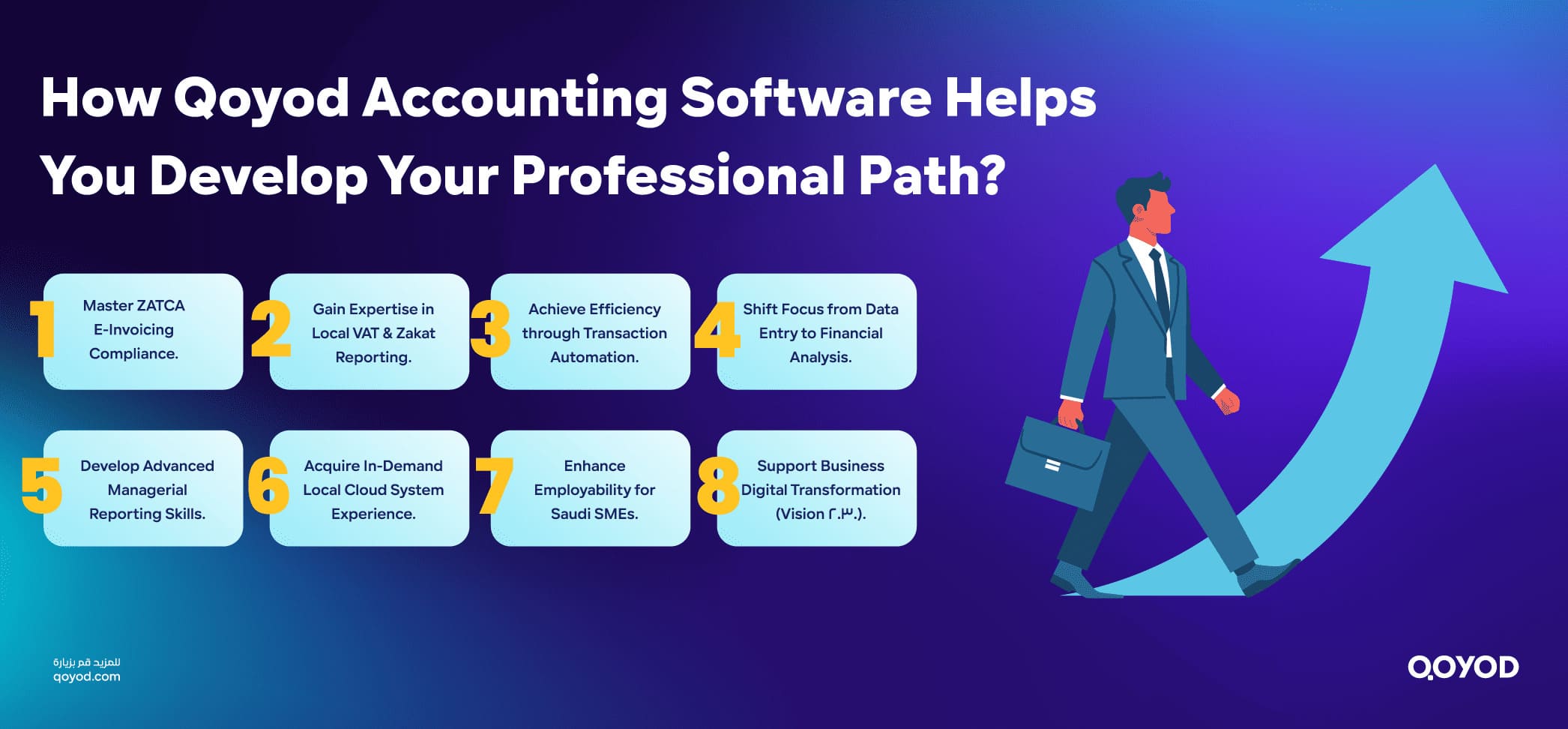
How Qoyod Accounting Software Helps You Develop Your Professional Path?
In the journey of Accountants’ Career Progression, theoretical knowledge is no longer the sole determinant, but rather practical and technical competence. Mastering modern, locally designed accounting software is an investment in your professional future.
Program Advantages in Automating Operations and Saving Time
Qoyod Accounting Software is not just a recording tool; it’s a partner in automation that enhances the accountant’s efficiency:
- E-Invoicing Compliance: Qoyod provides integrated solutions for issuing e-invoices (Fatoorah) compliant with ZATCA requirements without complications, reducing the likelihood of compliance fines.
- Automating Recurring Entries: The software helps you complete routine tasks automatically, saving valuable time for the Junior or Senior Accountant to focus on higher-value tasks like financial analysis.
- Ease of Report Preparation: With a single click, you can extract the necessary reports and financial statements for the monthly and annual closing process and submit VAT declarations.
How the Program Adds Value to Your Path as a Professional Accountant
Mastering a platform like Qoyod makes you a preferred candidate for promotion:
- Local Practical Experience: Your knowledge of a platform specifically designed to handle Saudi market requirements (such as dealing with VAT and Zakat) gives you a competitive advantage over other candidates.
- Transition from Executor to Analyst: Using Qoyod Accounting Software means spending less time on manual entry and more time analyzing the data the program provides, which is the skill required to move from Chief Accountant to Finance Manager.
Conclusion: Launching Towards the Peak of Accountants’ Career Progression
It has become clear that the Accountants’ Career Progression in Saudi Arabia is no longer a matter of waiting for experience; it is a strategic plan that requires working through 10 stages starting from Junior Accountant to a Financial Leader (CFO). Success in this path depends on integrating practical experience with complete familiarity with government regulations (such as the e-invoicing system in Saudi Arabia), and obtaining prestigious professional certifications. Don’t let routine operations hinder your progress.
Try Qoyod Accounting Software now to make your business operations easier and more accurate with solutions designed for Saudi companies.
Frequently Asked Questions about Accountants’ Career Progression in Saudi Arabia (FAQ)
What is Accountants’ Career Progression?
Accountants’ career progression refers to the sequence of roles and responsibilities an accountant advances through, starting as a junior and reaching senior leadership positions like Chief Financial Officer (CFO). This path emphasizes developing both technical and managerial skills according to Saudi market requirements.
What are the key stages of an accountant’s career path in Saudi Arabia?
The accountant’s career path in Saudi Arabia typically includes the following stages: Junior Accountant, Senior Accountant, Lead Accountant, Chief Accountant, Accounting Manager, Finance Manager, and finally CFO. Each stage offers different responsibilities, required skills, and earning potential, varying between private and government sectors.
What qualifications do you need to start a successful accounting career?
A bachelor’s degree in accounting or finance is essential, along with hands-on training in companies or CPA firms. Knowledge of accounting software (like Qoyod, SAP, Odoo), strong analytical skills, and effective communication are vital for career progression.
Are SOCPA, CMA, or CPA certifications necessary for promotion?
Obtaining professional certifications such as SOCPA (Saudi Organization for Certified Public Accountants), CMA, or CPA significantly boosts your promotion prospects, salary potential, and eligibility for leadership roles, especially in large organizations or multinational companies.
What is the difference between financial and management accountants?
Financial accountants focus on recording and reporting financial transactions and preparing financial statements. Management accountants analyze budgets, costs, and internal reports to support decision-making. Both roles are highly demanded in Saudi Arabia but have distinct career paths.
What are the most in-demand accounting software in Saudi Arabia?
Top accounting software in Saudi Arabia includes Qoyod, SAP, Odoo, Data Plus, and Oracle Financials. Expertise in cloud-based and e-invoicing compliant systems is a key advantage for accountants in today’s digital Saudi business environment.
How does career development differ in the public vs. private sectors?
The private sector typically offers faster advancement, higher earning potential, and diverse skill development. Public sector jobs provide job stability and benefits like social security. Many accountants shift to private firms to accelerate their career growth and income.
What is the average salary for accountants in Saudi Arabia based on experience and location?
Entry-level accountants in Saudi Arabia earn between SAR 4,500 and SAR 7,000 per month, with salaries increasing up to SAR 20,000 for CFO positions. Salaries vary by city (Riyadh, Jeddah, Khobar) and are influenced by professional certifications and years of experience.
What are the best tips to speed up accountant career progression?
Obtain professional certifications (SOCPA, CMA).
Master accounting software and financial analysis tools.
Attend training programs and finance workshops.
Build strong professional networks.
Show initiative by participating in key projects.
What are common mistakes accountants should avoid?
Not keeping up with changes in Saudi financial regulations.
Errors in recording transactions.
Poor communication with other departments.
Limiting themselves to one software without updating skills.
What technical and soft skills are essential for promotion?
Technical skills: Proficiency in accounting software, financial analysis, and report preparation.
Soft skills: Leadership, negotiation, time management, and performance under pressure.
How does digital transformation and e-invoicing impact accountants’ future?
Digital transformation and mandatory e-invoicing systems have redefined accounting roles in Saudi Arabia. Accountants must adapt to cloud-based systems and stay up-to-date with new technologies to maintain employability and thrive in the evolving market.
Sources and References That May Benefit You:
- Zakat, Tax and Customs Authority (ZATCA)
- Saudi Organization for Certified Public Accountants (SOCPA)
- Ministry of Human Resources and Social Development (HRSD)
- International Financial Reporting Standards (IFRS)