
















| Excerpt
AI is no longer exclusive to large corporations. Learn the practical steps to use ready-made AI for Business tools and how Qoyod transforms your structured data into an analytical and predictive powerhouse for growth. |
AI for Business (Artificial Intelligence) has moved beyond science fiction to become a tangible, everyday reality. For years, AI was associated only with giant corporations boasting massive budgets and huge databases, but that scene has completely changed.
Today, thanks to advancements in Generative AI and the accessibility of Machine Learning models as cloud services, AI is a readily available tool for every establishment, regardless of size. This makes AI for Business accessible to even the smallest enterprises, enabling them to leverage advanced accounting automation features.
What Does AI Mean for Your Business?
For small and medium-sized enterprises (SMEs), AI can be simply defined as the ability of your software to learn from data and act based on that learning, rather than relying on direct human commands. This includes tools that generate creative texts, automatically classify your invoices, or even predict demand for your products.
The Fundamental Shift: From Routine to Innovation
AI is driving a radical transformation in the work environment by changing how we handle time-consuming, routine tasks. Instead of your valuable team members spending time manually copying data from invoices, entering journal entries, or searching complex spreadsheets:
- AI takes over these tasks automatically with unmatched accuracy.
- It converts repetitive operations into automated procedures, eliminating burdensome clerical work.
This liberation from mechanical tasks allows business owners and employees to focus on strategy and creativity. Accountants can now spend their time analyzing performance instead of inputting numbers, and marketing teams can focus on relationship building instead of writing tedious drafts.
Added Value: Boosting Productivity and Improving Decision-Making
Integrating AI into your operations is not just an update; it’s a direct investment in your business growth. It offers two main values:
- Increased Productivity: When monotonous tasks are automated, overall speed and efficiency increase. An employee who took a day to input month-end data can complete the task in one hour with the help of AI, dedicating the remaining time to higher-value responsibilities.
- Improved Decision Quality: Humans cannot rapidly analyze millions of data points. AI does this, providing deep insights and accurate forecasts on customer behavior, cash flow, and market trends. This data-backed analysis ensures your investment, pricing, or inventory decisions are more informed and effective, ultimately leading to sustainable growth and increased profits for your growing business.
Accounting Automation: AI’s Role in Financial Management
The financial and accounting field is where the power of AI truly shines, especially for companies relying on integrated cloud systems like Qoyod Accounting Software. Here, AI doesn’t just act as an add-on; it functions as a core part of the system’s engine, transforming accounting from a historical recording process into a strategic analysis and future planning operation.
1. Data Entry and Classification Automation: Say Goodbye to Manual Errors
Routine tasks like dealing with thousands of receipts and invoices are the most time-consuming and error-prone. AI intervenes to address this challenge through advanced technology:
- How it Works: AI uses Optical Character Recognition (OCR) technology to automatically read uploaded financial documents (such as purchase invoices or expense receipts). Algorithms then extract essential data like the amount, date, and supplier name.
- Smart Classification: The system doesn’t stop at data extraction; it automatically classifies the transaction to the correct accounting account (e.g., classifying a fuel receipt as “Fuel and Transport Expenses”), based on its learning from past transaction patterns.
The Added Value of Accounting Automation in Qoyod:
This direct automation in systems like Qoyod Accounting Software yields immense value, crucial for compliance with local and international tax and invoicing regulations:
| Benefit | Description |
| Reduced Time | The data entry process is reduced from hours to mere minutes, freeing the accounting team to focus on analysis. |
| Increased Accuracy | Eliminating human errors from manual entry ensures that reports and financial statements, including Zakat and tax reports, are perfectly correct. |
2. Financial Analysis and Forecasting: Future-Proofing Your Decisions
AI transforms the historical data within Qoyod into predictive power that aids in future planning for the establishment:

- Cash Flow Forecasting: AI analyzes seasonal sales patterns, and due dates for customer and supplier invoices, to provide accurate forecasts of future liquidity. This helps managemen to prepare potential cash deficits or efficiently utilize financial surpluses.
- Sales and Demand Prediction: The system can analyze past sales data in Qoyod, considering external factors (like events and holidays), to predict sales volume for upcoming periods. This is a critical factor for improving inventory management and procurement planning.
- Fraud and Anomaly Detection: AI algorithms excel at identifying unusual patterns that might escape a human auditor. For example, the system can detect attempts to record repeated expenses at fixed amounts or transactions conducted at unusual times, sending an immediate alert to management regarding potential fraud or significant error.
3. The Role of Qoyod Cloud System as an AI Platform
AI cannot function efficiently without clean, standardized data. This is where the vital role of a cloud accounting system like Qoyod emerges:
- The Essential Raw Material: Qoyod serves as the container that aggregates and organizes data (PoS sales, bank expenses, supplier invoices, inventory movement) in one unified location. This reliable data is the essential raw material that machine learning algorithms need to “train” and generate accurate forecasts.
- Data Integration: The cloud system ensures data is synchronized and real-time across all company departments. This means the AI is always operating with the latest available information, vital for making fast decisions for businesses.
Overcoming AI for Business Challenges for SMEs
Despite the enormous opportunities offered by AI for Business, small and medium-sized enterprises (SMEs) face specific challenges when attempting to adopt these technologies. Understanding these obstacles and providing practical solutions is key to a successful transition to an AI-backed work environment.
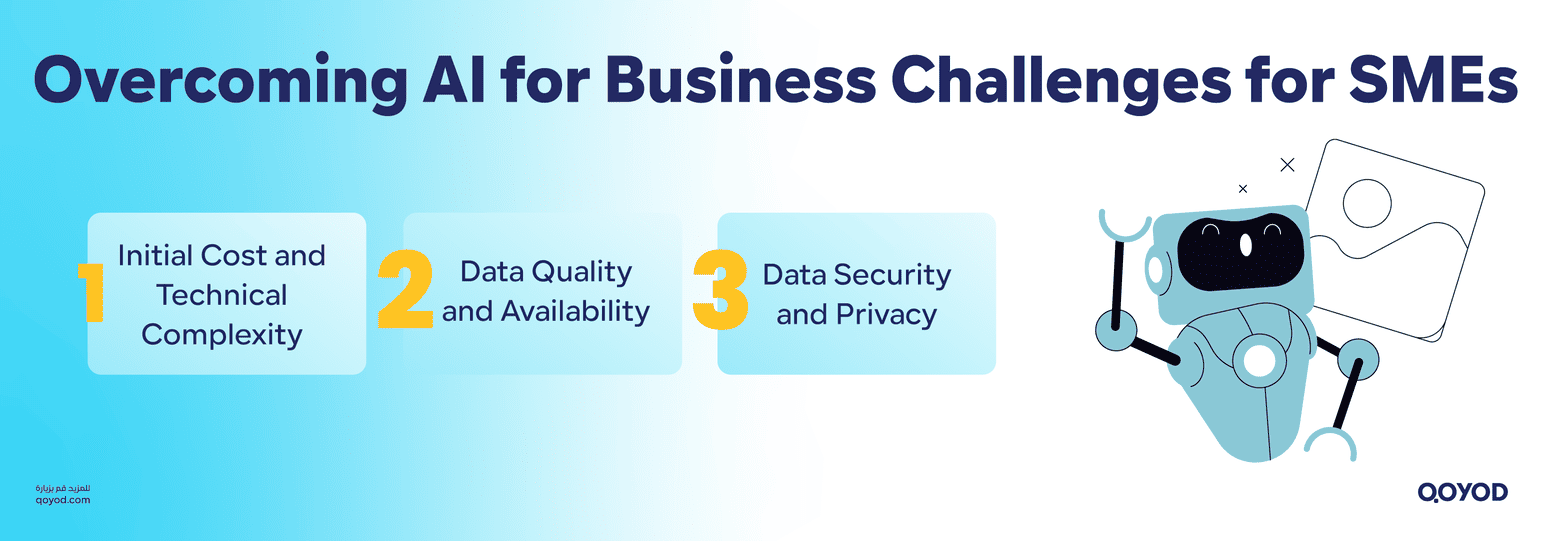
1. Challenge 1: Initial Cost and Technical Complexity
Historically, AI required huge investments in infrastructure, hiring specialized data scientists, and developing custom algorithms, which is beyond the budget and technical expertise of most small businesses.
| Challenge | Practical Solution | Detail |
| Cost & Complexity | Focus on ready-made tools and SaaS solutions | Instead of costly custom development, SMEs should rely on Software as a Service (SaaS) that integrates AI features within a simple monthly subscription. These tools are ready-to-use (like AI-embedded features in Qoyod Accounting Software) and eliminate the need for specialized development teams or complex infrastructure, making AI accessible and affordable. |
2. Challenge 2: Data Quality and Availability
AI relies entirely on data; if the data is disorganized, incomplete, or error-ridden (Garbage In, Garbage Out), the resulting predictions and analyses will be unreliable and useless. Small businesses often lack a central system to organize their data.
| Challenge | Practical Solution (Role of Qoyod) | Detail |
| Data Quality | Using Organized Management Systems (e.g., Qoyod) | The solution is establishing a robust, central database. Organized management systems like Qoyod collect classified data (sales, expenses, inventory) in one location with unified standards. This ensures: First, every transaction is accurately classified (via the automatic classification feature). Second, the data is organized and ready to feed advanced AI algorithms, transforming raw data into high-quality raw material for analysis and prediction, which is essential for accurate compliance with ZATCA regulations. |
3. Challenge 3: Data Security and Privacy
Concerns about sensitive financial data or customer information leaking to external or public tools are major obstacles to AI adoption.
| Challenge | Practical Solution | Detail |
| Security & Privacy | Adherence to Certified Security Standards | Small businesses must choose AI solutions that comply with global data security standards, such as SOC2 Type 2 certification. These certifications ensure service providers maintain the security and privacy of your data in the cloud. Crucially: Avoid entering sensitive financial or customer information into free or public tools (like generic chatbots). Instead, use AI solutions integrated within your trusted administrative system (like the automated features in Qoyod) to ensure data remains in a safe and protected environment. |
Learn about the features of Qoyod cloud accounting software program
The Future Starts with Organized Data
AI for Business is now an undeniable driving force in the business world. While the discussion about automation might raise concerns about job replacement, it must be clearly stated that AI is fundamentally a powerful assistant, not a substitute for the human mind.
AI excels at dealing with numbers, analyzing patterns, and performing routine tasks with unerring speed and accuracy. However, it lacks human intuition, strategic creativity, and the ability to build complex relationships with customers and employees. Your role as a business owner or financial manager transforms from a data recorder to an analyst, supervisor, and strategic decision-maker, utilizing the insights provided by AI to elevate your business efficiency.
Qoyod’s Message: The Organized System is the Starting Point
Our clear message is that the key to success in the age of AI begins with administrative discipline. An establishment with a regulated and integrated cloud accounting system like Qoyod Accounting Software is the fastest to adopt AI technologies and reap their benefits.
Why? Because Qoyod provides the ideal environment AI needs to operate:
- Clean and Reliable Data: The system ensures your financial data (sales, expenses, inventory) is organized, classified, and updated in real-time. This is the clean fuel AI algorithms rely on for accurate prediction.
- Seamless Integration: Qoyod provides a platform where AI features are integrated securely, eliminating the need to worry about sensitive data leakage or entering it into unreliable external tools.
AI is the engine, and Qoyod Accounting Software is the infrastructure. Invest in organizing your data today to benefit from the power of prediction and accounting automation tomorrow. Start your journey toward automation and let AI handle the routine tasks while you focus on leading your business to the top.
Try Qoyod Accounting Software now to make your business operations easier and more accurate with solutions designed for businesses worldwide.
FAQ
What is AI accounting automation?
AI accounting automation is the use of technologies like machine learning, optical character recognition (OCR), and predictive analytics to handle repetitive accounting tasks automatically.
Instead of manually entering, matching, and classifying transactions, AI-powered software reads invoices and receipts, posts them to the right accounts, reconciles bank feeds, and even flags anomalies for review.
How does AI in accounting help my business grow faster?
AI frees up time and resources so your team can focus on strategy, sales, and customer relationships instead of routine bookkeeping.
By delivering real-time financial insights and more accurate data, AI helps you:
Spot issues (like cash flow gaps) earlier
Make faster decisions on pricing, hiring, and investments
Scale operations without linearly increasing finance headcount
Which accounting tasks can AI automate?
Typical tasks that AI accounting tools can automate include:
Data entry from invoices, receipts, and bills
Bank and credit card reconciliation
Expense categorisation
Recurring journal entries
Accounts payable and receivable workflows
Generating dashboards and routine reports
Many modern tools can also support fraud detection and compliance checks in the background.
Will AI replace human accountants?
No. AI is best at repetitive, rules-based, and data-heavy tasks.
Human accountants are still essential for:
Interpreting the numbers
Advising management
Designing internal controls
Planning tax and long-term strategy
In practice, AI acts like a junior assistant that handles the grunt work so accountants can move up the value chain into advisory and strategic roles.
Is AI accounting only for large enterprises, or can small businesses use it too?
AI accounting is now very accessible for small and medium-sized businesses (SMBs/SMEs).
Cloud-based platforms bundle AI features (like automatic classification and cash-flow forecasts) into affordable subscriptions, so you don’t need a large IT team or custom development. Many small businesses already use AI-powered tools inside products like QuickBooks, Xero, and other SaaS platforms.
How does AI improve accuracy and reduce risk in accounting?
AI reduces human error by:
Eliminating manual retyping of amounts and dates
Automatically matching invoices, payments, and bank lines
Flagging duplicate or unusual transactions
Maintaining a clear audit trail of who did what and when
This leads to cleaner books, fewer reconciliation issues, and better readiness for audits or tax inspections.
What do I need in place before adopting AI accounting tools?
To get real value from AI, you should first ensure that you have:
A modern cloud accounting system (instead of scattered spreadsheets)
Consistent and well-structured chart of accounts
Connected bank feeds and, ideally, payment and sales channels
Clear internal processes for approvals and access rights
Once your data is centralised and structured, AI can automate and analyse it much more effectively.
How does AI help with cash-flow management and forecasting?
AI tools analyse historical inflows and outflows, payment behaviour, seasonality, and upcoming invoices/bills to:
Predict future cash-flow curves
Highlight periods where you may face a shortfall
Suggest when to follow up on late payers or reschedule payments
This allows you to make proactive decisions about financing, inventory, and spending instead of reacting when cash is already tight.
Is my financial data safe with AI-powered cloud accounting?
Reputable AI accounting platforms typically use:
Encrypted connections (HTTPS/TLS)
Encrypted data storage
Role-based access controls and audit logs
Regular backups and security monitoring
However, you should still:
Choose vendors with strong security certifications or compliance statements
Limit access based on roles
Avoid pasting sensitive financial data into random, non-enterprise AI chat tools
Security is a shared responsibility between the provider and your internal policies.
How can I measure the ROI of AI accounting automation?
You can track ROI by measuring changes in:
Time saved: hours per month no longer spent on manual entry, reconciliation, and report preparation
Headcount / outsourcing cost: reduced reliance on external bookkeepers or overtime
Error rates: fewer corrections, write-offs, and penalty fees
Decision speed and quality: faster closing cycles, more frequent reporting, and better cash-flow control
Many small businesses report large productivity gains and cost savings once they fully automate core bookkeeping workflows.