This article breaks down the core concepts, levels, and functions of effective Management. It then demonstrates how modern tools like Qoyod Accounting Software are indispensable for small and medium-sized businesses to achieve better financial control and strategic decision-making. |
What is the Definition of Management?
Management is an integrated process aimed at achieving organizational goals with efficiency and effectiveness by executing a set of core functions, including:
- Planning: Defining objectives and outlining suitable strategies.
- Organizing: Allocating tasks and coordinating human and material resources.
- Directing and Leading: Motivating employees and guiding them toward the goals.
- Controlling: Monitoring performance, ensuring discipline, and taking corrective action when necessary.
Management seeks to use available resources in the best possible way, minimizing costs and maximizing efficiency, making it the central factor in the success of any organization, whether a commercial company, a government institution, or a non-profit organization.
What is the Concept of Management from a Scholar’s Perspective?
Several definitions have been presented by scholars over the decades, focusing on different aspects of the managerial process. Some of them are summarized below:
Frederick Taylor
Taylor’s definition focuses on accuracy and effectiveness in task execution. According to him, Management means determining what workers must do, and then ensuring they perform these tasks in the best and cheapest ways. This highlights the importance of prior planning and supervising workflow to guarantee efficiency.
Ralph Davis
Davis defines it as the work of executive leadership. Through this definition, it is viewed as a process related to leadership and direction for achieving organizational objectives.
Henri Fayol
For Fayol, Management is the ability to forecast the future and plan accordingly, alongside organizing, commanding, coordinating activities, and controlling. This points to the holistic nature of Management as an integrated process requiring a future vision and distinct organizational capabilities.
Livingstone
Livingstone defines it as the function that allows achieving a goal in the best ways, at the lowest cost, and in a timely manner using available potential. This definition notably emphasizes the importance of efficiency and effectiveness in resource utilization.
The Importance of Management in Achieving Organizational Goals
Management plays a pivotal role in directing organizations toward achieving their goals efficiently and effectively. Through its core functions, planning, organizing, directing, and controlling, management ensures the optimal utilization of available resources, whether human, material, or financial.
Management contributes to:
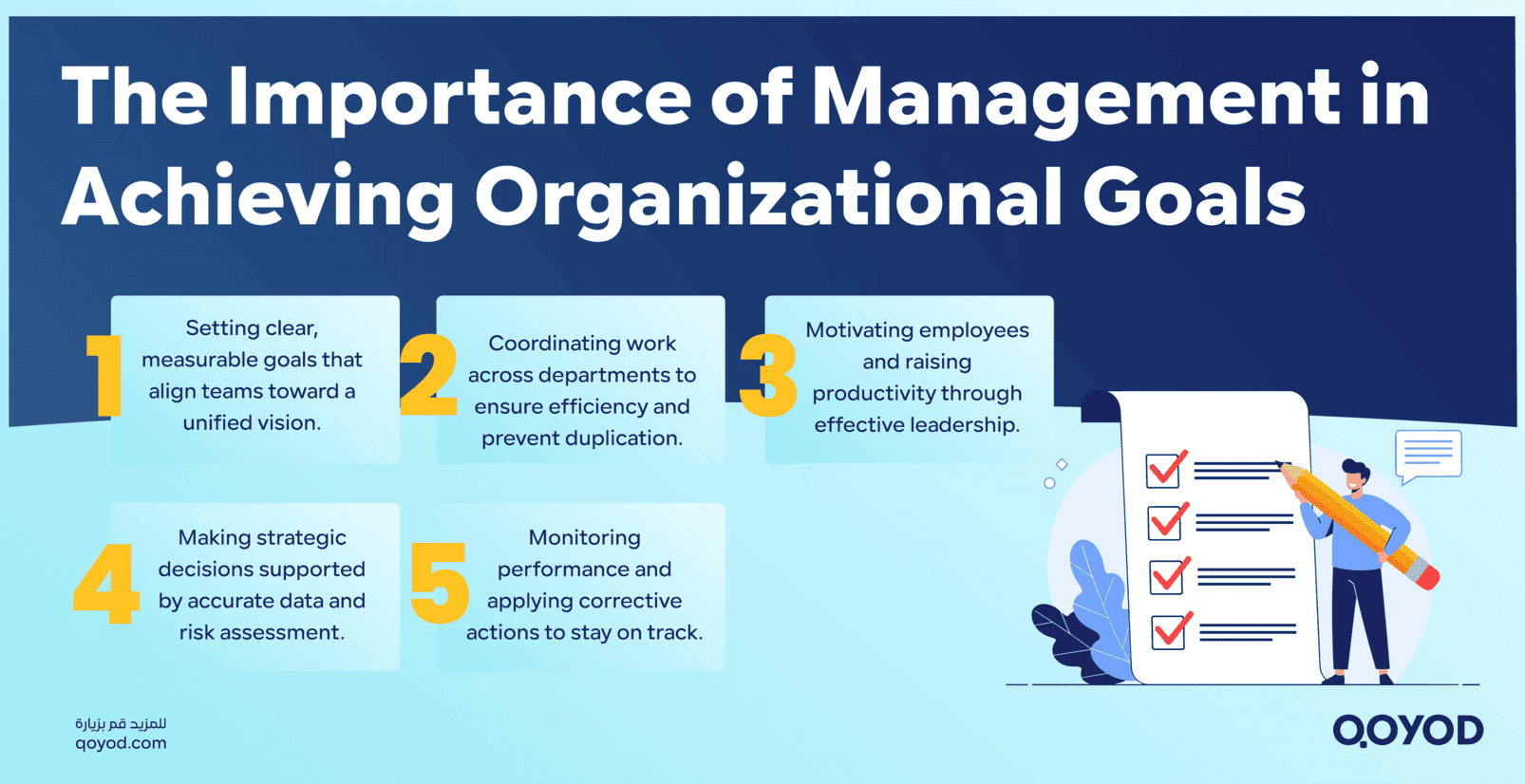
- Setting clear and measurable goals that unify efforts toward a shared vision.
- Coordinating work between departments and teams to achieve integration and prevent duplication or waste.
- Motivating employees and increasing productivity through effective leadership styles based on communication and support.
- Making strategic and tactical decisions based on accurate data analysis and risk assessment.
- Monitoring performance and evaluating results to ensure the correct direction is maintained and necessary adjustments are made promptly.
In short, Management is the mastermind of any organization; it transforms theoretical goals into practical, tangible results. Without effective Management, even the best resources and potential are susceptible to chaos and decline.
What Are the Levels of Management?
Organizations are typically divided into three primary Management levels, each with a specific role and nature of work.
| Management Level | General Description | Key Tasks |
| Top Management | Represents the peak of the administrative hierarchy | – Setting the vision and long-term goals
– Making critical, high-impact decisions |
| Middle Management | A link between top and operational management | – Implementing strategies through operational plans
– Coordinating between departments – Overseeing the achievement of objectives |
| Operational/Supervisory Management | Located at the base of the administrative hierarchy | – Executing day-to-day tasks
– Direct supervision of employees – Applying policies and instructions |
What Are the Types of Management?
Management can be classified into several types, each focusing on a specific aspect of the work and relying on defined methods and strategies to achieve goals. Here is a comprehensive overview of the most important types:

Strategic Management
This is concerned with defining the organization’s vision, mission, and long-term goals. It is a process that involves setting and developing strategies to achieve the organization’s overall direction and ensuring all activities align with the major objectives. It relies on analyzing the internal and external environment, identifying opportunities and challenges, and setting plans aimed at strengthening the organization’s competitive position.
Tactical Management
This focuses on setting short-term executive plans to achieve specific goals within the general framework determined by Strategic Management. This type deals with the day-to-day details of executing major strategies and achieving interim objectives. It specifies required resources, allocates tasks, and determines schedules to ensure desired results are met on time.
Operational Management
This focuses on managing the daily operations of the organization. It is concerned with organizing and directing routine activities to ensure the efficiency and effectiveness of daily performance. The main goal of Operational Management is to improve processes and ensure smooth daily workflow in alignment with tactical and strategic plans.
Bureaucratic Management
This relies on the strict application of formal rules and regulations. In this type, work is organized through precisely defined administrative structures where every individual has a specific role following known procedures and regulations. It is characterized by discipline but can be slow to respond to changes.
Democratic Management
This involves all organization members in the decision-making process. This approach is more flexible and enhances the sense of responsibility among individuals. It contributes to building a positive work environment and stimulating creativity and innovation by involving employees in decisions that affect them.
Autocratic Management
In Autocratic Management, authority is concentrated in the hands of one person who makes all decisions. It is characterized by the speed of decision-making and execution but may lack interaction and participation from other organization members, which can affect morale and creativity.
Charismatic Management
This relies on the leader’s personality and charm to guide and motivate individuals. A charismatic leader possesses a special ability to influence others and inspire them to achieve common goals. This type is characterized by a focus on personal relationships and team spirit.
Business Management
Business Management is concerned with organizing and directing the activities of commercial institutions to achieve profit objectives. It includes resource planning, managing business operations, developing marketing and sales strategies, in addition to managing financial resources to achieve growth and profitability.
Project Management
Project Management is concerned with planning, executing, and monitoring projects to achieve their specific objectives. This includes:
- Defining goals.
- Allocating resources.
- Setting timelines.
- Managing risks to ensure the project is completed on time and within the specified budget.
What Are the Management Functions and Their Definitions?
The Management functions represent the fundamental pillars upon which any organization rests to achieve its goals efficiently and effectively. These functions include five main points:
1. Planning (Planning)
- The process through which the organization’s future goals are determined, and the necessary plans and strategies are set to achieve these goals.
- Planning relies on analyzing the internal and external environment of the organization to avoid risks and exploit opportunities.
- It is considered the starting point upon which the remaining Management functions are built.
2. Organizing (Organizing)
- Involves arranging resources and activities systematically to achieve the planned goals.
- Includes allocating tasks, defining authorities and responsibilities, and building the appropriate organizational structure.
- Organizing helps ensure effective communication and information flow between different Management levels.
3. Staffing (Staffing)
- The process of selecting and appointing the right individuals for the different jobs in the organization.
- It also includes training and developing employees to ensure their qualification and the achievement of required performance.
- This function is one of the crucial factors for the organization’s success, as the efficiency of performance depends on the quality of the staff.
4. Directing (Directing)
- Involves leading and motivating individuals within the organization toward achieving goals.
- It requires strong leadership skills to foster cooperation, commitment, and achieve a positive work environment.
- Includes guidance, motivation, communication, and conflict resolution.
5. Controlling (Controlling)
- Monitoring the performance of activities and ensuring the goals are achieved as planned.
- It is done by measuring performance, comparing results with plans, and taking corrective actions when necessary.
- Controlling ensures the organization stays on the right track toward achieving its objectives.
Examples of Key Managerial Skills
Successful Management requires a set of essential skills that managers must develop to effectively lead their teams and achieve the institution’s goals. Here are the most important of these skills:
1. Leadership Skills
- Supervision and Motivation: The manager’s ability to lead and motivate the team to achieve optimal performance and institutional goals.
- Relationship Management: Fostering cooperation and team spirit among organization members to create a positive and productive work environment.
2. Strategic Planning and Vision Skills
- Strategic Planning: The ability to set long-term plans based on a comprehensive analysis of expectations and the surrounding environment.
- Adaptability and Flexibility: Adjusting plans and strategies to confront new changes and challenges.
3. Communication Skills
- Effective Communication: Conveying information clearly and effectively to ensure employees understand tasks and execute them correctly.
- Negotiation and Relationship Building: Negotiation skills help find compromises that meet the interests of all parties.
4. Organizational Skills
- Task Organization and Prioritization: Organizing work and determining the most important tasks to ensure goals are achieved effectively.
- Time and Project Management: Planning schedules, tracking work progress, and ensuring deadlines are met.
How Qoyod Accounting Software Supports Management for SMEs
Qoyod Accounting Software is a vital tool for effective Financial Management and overall business control. Here are the points highlighting its importance for small and medium-sized businesses (SMEs):
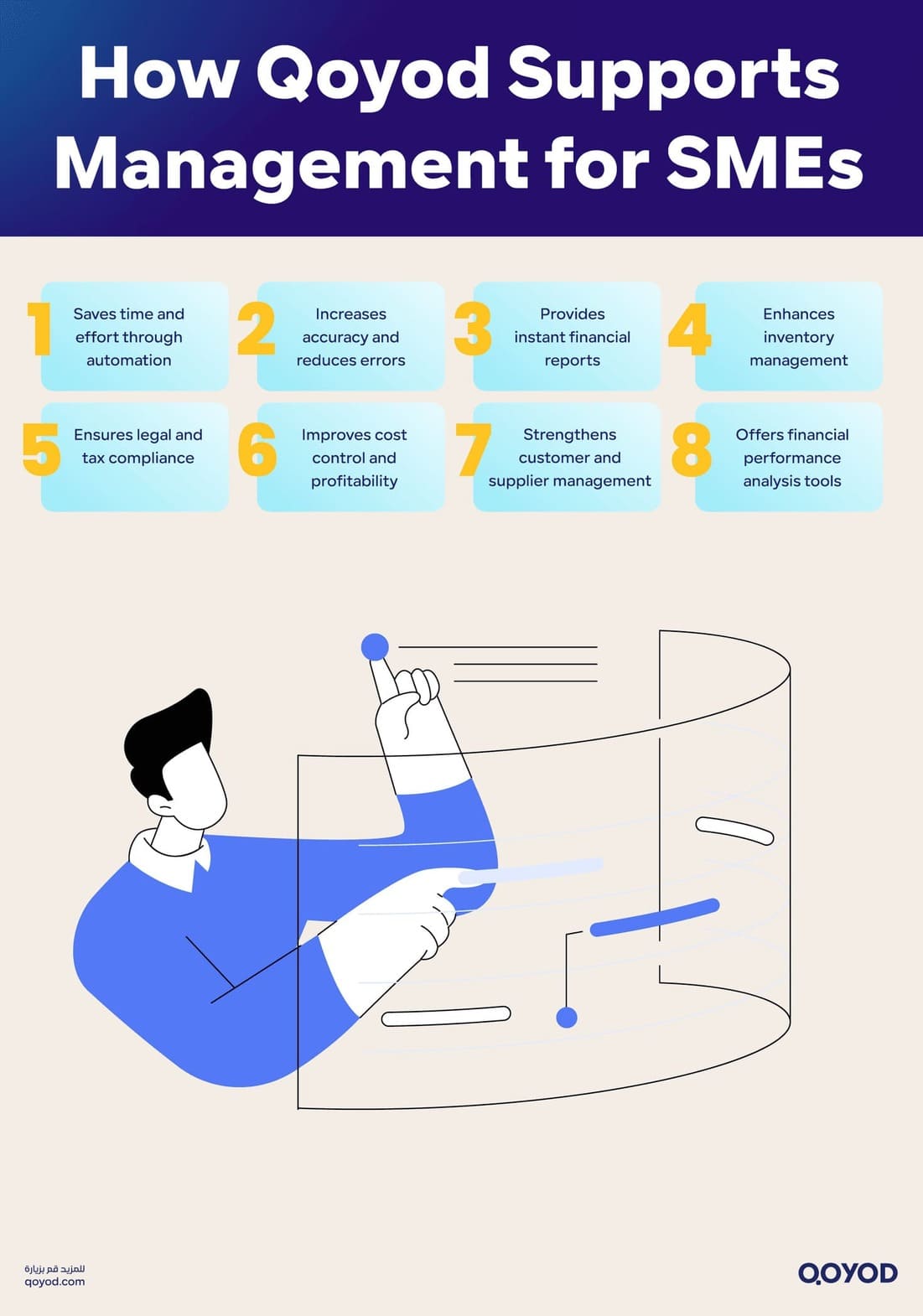
- 1. Saving Time and Effort through Automation:
Qoyod automates repetitive accounting processes, such as invoice entry, payment processing, and daily journal entries. This reduces the need for intense manual work, freeing up valuable time for management to focus on more strategic tasks. - 2. Increased Accuracy and Reduced Error:
Minimizing human errors in financial calculations is a key advantage of accounting software. Using Qoyod, data is recorded uniformly and automatically, enhancing the accuracy of financial information and reducing risks associated with mistakes. - 3. Access to Instant Financial Reports:
The software allows instant access to up-to-date financial reports, such as income statements, balance sheets, and cash flow reports. These reports help Management monitor the financial status and make informed decisions quickly and effectively. - 4. Effective Inventory Management:
Qoyod simplifies the monitoring of inventory levels and goods costs, helping management reduce waste and optimize resource utilization. - 5. Ensuring Legal and Tax Compliance:
The software ensures that accounting processes align with international accounting standards and local regulations (such as e-invoicing requirements), which facilitates compliance with tax and regulatory requirements and reduces legal risks. - 6. Cost Control and Profitability Improvement:
Expenses and revenues can be tracked in detail and accurately, allowing Management to analyze and control costs, and work on improving profit margins. - 7. Improved Customer and Supplier Relationship Management:
The software facilitates the management of accounts receivable and payable, contributing to improved liquidity and building stronger relationships with customers and suppliers. - 8. Financial Performance Analysis Tools:
Tools like Qoyod provide analytical features that help Management regularly assess financial performance, such as financial ratio analysis and monitoring key performance indicators (KPIs), enabling early corrective action.
Frequently Asked Questions (FAQ)
What is the definition of Management?
Management is the process of using an organization's available resources (human, material, financial, and informational) in a structured manner to achieve goals with the highest degree of efficiency and effectiveness. It involves defining goals, planning how to reach them, organizing roles and tasks, directing and motivating individuals, and then monitoring results and correcting deviations. It is a comprehensive system that coordinates efforts across departments to ensure everyone works toward a unified vision.
Why is Management essential for organizational success?
Management is the organizational intelligence that converts available resources into tangible results. Without effective Management, efforts can be scattered, and resources wasted. It helps set clear goals, distribute roles, prevent work duplication, and make data-driven decisions. It also ensures continuous performance monitoring, early error detection, and course correction. Strong Management means a better ability to face crises, seize opportunities, and achieve sustainable long-term growth.
What is the difference between Strategic, Tactical, and Operational Management?
Strategic Management focuses on the big picture: formulating the mission, defining the competitive position, setting long-term goals, and analyzing the environment. Tactical Management operates at the departmental level, translating strategic goals into medium-term programs and short-term plans, allocating resources, and setting timelines. Operational Management deals with the day-to-day execution of tasks: scheduling work, monitoring immediate performance, solving routine problems, and ensuring smooth processes. The main difference lies in the time horizon and the level of detail.
What are the core Management functions in any organization?
The five core Management functions are Planning, Organizing, Staffing, Directing, and Controlling. Planning sets goals and the paths to achieve them. Organizing divides work and structures authority. Staffing involves recruiting, training, and developing talent. Directing means leading, motivating, and resolving conflicts. Controlling ensures performance aligns with plans by measuring outcomes and taking corrective action. These functions are interconnected and operate in a continuous cycle to improve performance.
How does Qoyod Accounting Software support Management?
Qoyod Accounting Software supports Management by automating financial processes, saving significant time. It provides instant and accurate financial reports (e.g., income statements, cash flow) that help management understand profitability, make fast, data-driven decisions, and improve tax compliance (e-invoicing). It also facilitates inventory tracking and cost control, linking the financial administration directly to the general management of the institution, thereby supporting continuous planning and control.
In Conclusion
Management is the backbone of the success of any organization or project, combining science and art, meticulous planning, and flexibility to adapt to rapid changes in the business environment. The importance of Management lies in empowering individuals, achieving desired goals, and ensuring sustained growth and continuous development. Therefore, investing in the development of managerial skills is not just an option but a necessity that enables institutions to face challenges and seize new opportunities to remain at the forefront of the competition.
Among the tools that contribute to enhancing the effectiveness of Financial Management and overall administration, Qoyod Accounting Software stands out as a leading integrated accounting program, offering innovative solutions including point-of-sale systems, e-invoicing, and other services at highly competitive prices.
Try Qoyod Accounting Software now to make your business operations easier and more accurate with solutions designed for modern businesses.
We invite you to experience Qoyod free for 14 days to see for yourself how this program can facilitate the efficient and professional Management of your financial and administrative affairs.
Join our inspiring community! Subscribe to our pages on LinkedIn and Twitter to be the first to see the latest articles and updates. It’s an opportunity for learning and development in the world of Management, Accounting, and finance. Don’t miss out, join today!