| Expert Summary:
This comprehensive guide details the essential roles of an inventory manager, the importance of professional inventory management for small/medium-sized businesses, and contrasts traditional methods with digital automation. It provides crucial criteria for selecting the best cloud accounting system and inventory management software, like Qoyod, to optimize your global business operations. |
For any small or medium-sized business (SME), the inventory manager acts as the central pivot in the flow of goods, from the moment a shipment arrives until final disposition or physical count. Their responsibilities begin with receiving materials, ensuring they match approved purchase orders and invoices. This involves a meticulous review of received quantities and a quality inspection to rule out defects or shortages. Once the shipment is verified, the manager moves on to recording the movement in the system or inventory ledger, documenting all inventory addition procedures with transparency, and issuing what is commonly known as a Stock Receiving Note or Inventory Addition Voucher.
Storage is more than simply placing items on shelves. The inventory manager is committed to organizing and arranging products using scientific methods that ensure easy handling and maximum utilization of storage space. They rely on clear categorizations, such as fast-moving or perishable goods, and use barcode technology or electronic classification to accurately map locations and speed up the physical count process.
The periodic physical count remains one of their most complex tasks, requiring them to match the physical stock with the records. This count reveals any significant variances, whether shortages or overages. If material variances appear, partial entries such as “Debit: Inventory Loss Account, Credit: Inventory Account” are processed to account for the actual loss after the count, ensuring financial accuracy.
Moreover, their duties extend beyond storage and physical counts. They continuously monitor inventory levels to prevent stockouts or excessive inventory, and they prepare a regular report for management on the actual status of items. The inventory manager also oversees the issuance of stock, whether for internal consumption or sales dispatch, ensuring it is executed via formal authorizations and accurately documented procedures.
Another vital aspect is strict adherence to safety and security protocols. They supervise the placement of firefighting equipment, manage surveillance systems, and monitor ventilation and cleanliness to protect goods and employees from fire or theft. Coordination with other departments is an essential duty, involving continuous communication with purchasing regarding market needs, with accounting to record entries resulting from stock movements, and with sales to confirm timely product deliveries.
The documentation of movements and transactions is fundamental to control against loss or manipulation. The inventory manager is required to issue formal authorizations for every internal and external inventory movement, instantly updating the company’s system, whether operations are manual or via accounting software and smart systems.
Thus, the roles of an inventory manager converge to embody a complete plan for controlling, managing, and protecting the company’s warehouse assets, every morning, under every shelf and aisle of the storage facility.
Essential Skills for the Modern Inventory Manager
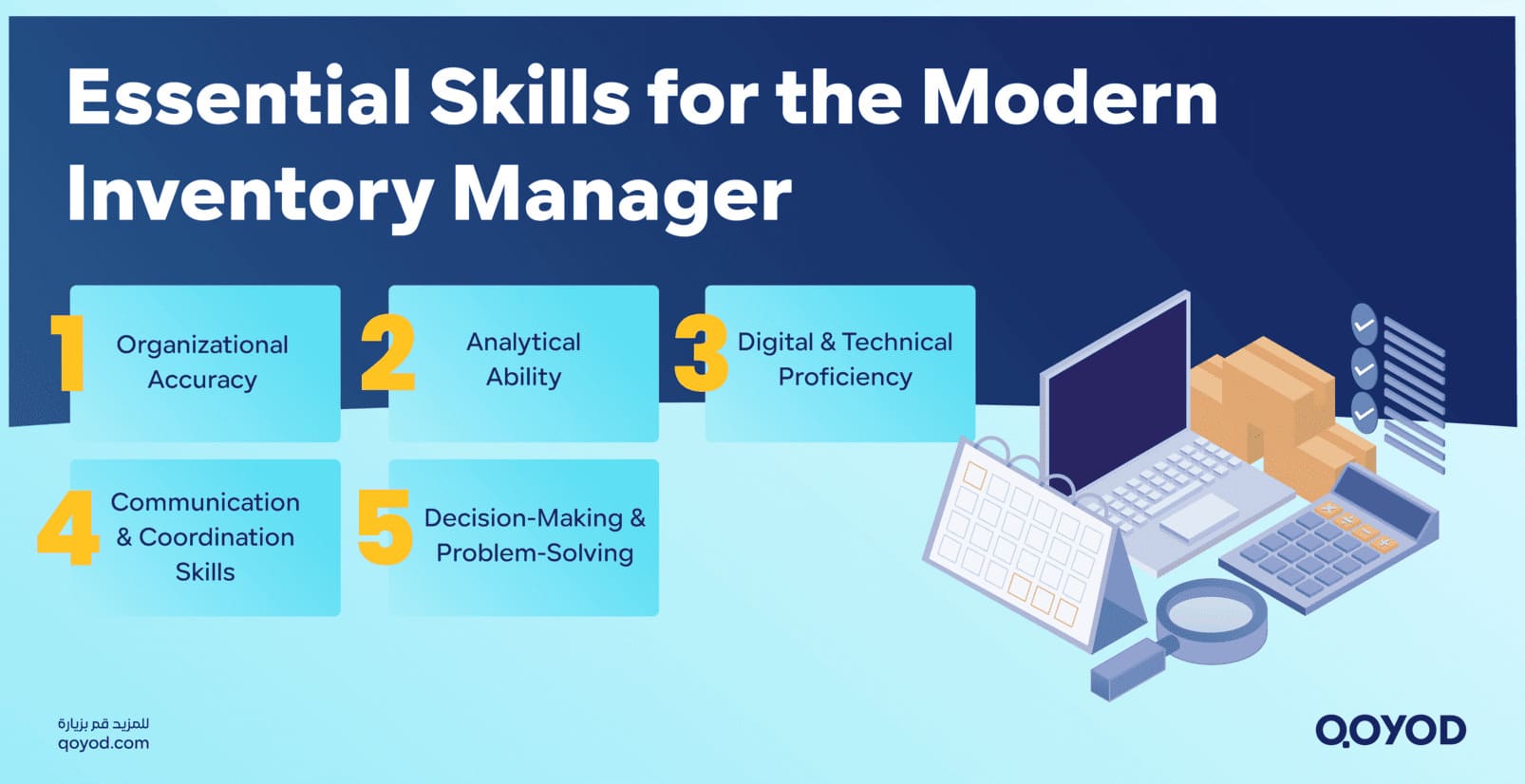
A successful inventory manager requires a comprehensive skill set that combines high discipline, accurate analysis, understanding of technological systems, and team communication. This combination is the foundation for successful inventory management in modern SMEs.
-
Organizational Accuracy and Analytical Capability
Organizational accuracy is critical when receiving and shelving goods, as the inventory manager must ensure shipments match orders and that every item is stored in its correct location, with precise data recorded for every movement. This accuracy is further demonstrated in the manager’s ability to detect variances during a count and analyze the root causes of shortages or surpluses to adjust warehouse operations and take prompt corrective action.
They must build solutions based on analyzing count reports, sales movement, and expiration date histories, which aids in planning new stock acquisitions or scientifically reducing damaged or obsolete inventory.
-
Proficiency in Digital Accounting and Inventory Systems
With the advancement of cloud accounting systems and modern software, using inventory management software and digital systems has become a key part of the inventory manager’s work. They must be proficient in computer applications such as Excel spreadsheets, Enterprise Resource Planning (ERP) systems, and handling barcode scanners and smart sensors to document receiving, issuance, and counts instantly.
Digital literacy allows the inventory manager to complete movement registration and data analysis rapidly, preparing periodic reports that support decision-making and reduce the time lost due to manual documentation.
-
Communication and Coordination Skills with Work Teams
At the heart of inventory management is continuous communication with the purchasing, sales, and accounting departments. The inventory manager conveys needs, reports stock shortages or surpluses, and coordinates schedules for counts or handling. Effective communication skills ensure smooth operations and facilitate the swift resolution of sudden issues, such as stock depletion or item damage, through quick coordination with the relevant departments.
Good communication reflects in preparing and reviewing formal documents,like purchase orders or stock issuance notes with the specialized teams, which achieves precise control over operations and enhances the overall performance efficiency of the business.
These combined skills significantly impact the control of corporate resources, driving business growth and boosting the operational efficiency of the warehouses.
The Importance of Professional Inventory Management Software for Business Success
Professional inventory management plays a pivotal role in building the sustainability and success of any organization. Its importance is not limited to mere storage operations but encompasses an interconnected chain of activities that directly impact financial and operational performance.
-
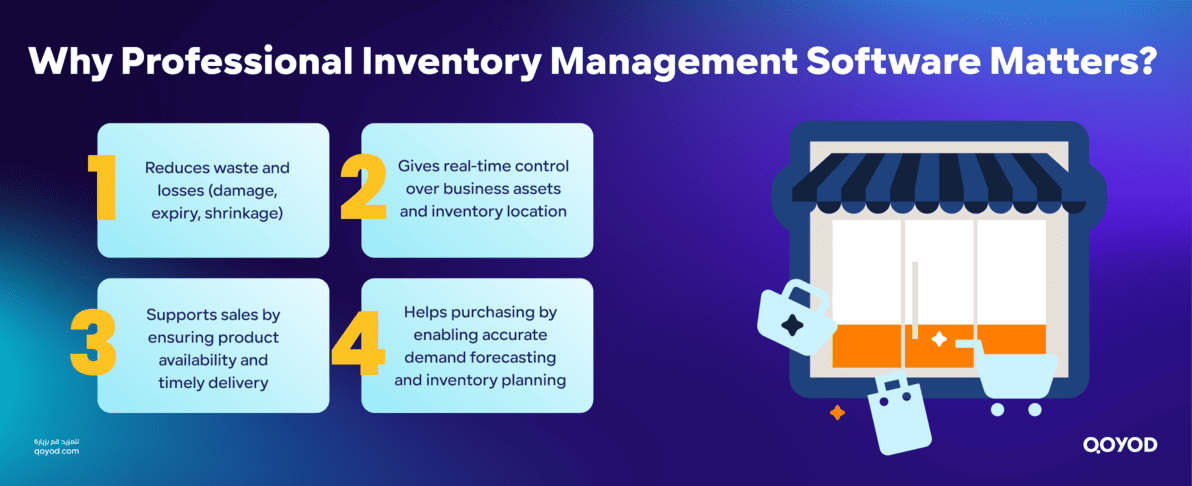
Reducing Waste and Loss
When control and efficiency standards are applied to receiving, storing, and issuing items, the losses resulting from damage or expiration decrease, particularly in businesses dealing with sensitive goods like food products or pharmaceuticals. Similarly, the probability of significant variances during physical counts is reduced, limiting financial waste from obsolete or lost inventory.
-
Achieving Effective Control Over Business Assets
Accurate inventory management allows for better real-time tracking of movements, knowledge of the actual location of items, and periodic reconciliation of balances. This prevents manipulation or theft and increases the reliability of operational and financial asset data.
-
Supporting Sales and Purchasing Operations
Smart inventory management ensures that required products are available to customers on time and without delay, which increases customer satisfaction and enhances their loyalty, helping the sales team respond quickly to orders. On the other hand, inventory management supports documented purchasing decisions by providing accurate data on required quantities and forecasting future demand.
Additional Points on Inventory Management Importance
- Improved Cash Flow and Cost Control by reducing capital tied up in inventory.
- Increased efficiency of the work cycle and production, enhancing the capacity to quickly meet large or sudden orders.
- Support for strategic decision-making based on accurate reports and analyses regarding inventory turnover, spoilage, demand rate, and safety stock levels.
- Reduced costs resulting from emergency purchases or accelerated replacement in case of stock depletion.
- Achieving a competitive advantage in the market through intelligent response to sudden changes in supply and demand.
- Improved supplier relationships through accurate detection of needed items, avoiding delayed orders or the accumulation of unwanted surplus quantities.
Inventory management is a strategic pillar that contributes to sales growth, strengthens customer trust, and improves the organization’s efficiency across various market conditions.
For a deeper dive into financial concepts, read this: [ IFRS Inventory Valuation Standards]
Digital Automation vs. Traditional Inventory Management: Challenges
| Challenge Category | Digital Automation | Traditional/Manual Management |
| Initial Investment | High upfront cost for hardware, software, and employee training, which can be a barrier for SMEs. | Low initial cost, relying on simple ledgers, paper documentation, and manual processes. |
| Implementation Complexity | Requires careful planning to ensure smooth integration with existing financial and operational ERP systems. | Simple to start but becomes overwhelmingly complex and slow as the business grows. |
| Change Resistance | Some employees may hesitate to adapt to new digital systems, requiring effective change management and continuous education. | Familiarity and comfort with existing routines, but lacks efficiency and scalability. |
| Data Security | Exposes data to cyber risks, necessitating advanced security measures, data encryption, and access controls. | Risk of data loss from physical damage (fire, theft) or human error (misfiling, incorrect entries). |
In Summary:
While traditional inventory management faces issues with accuracy, speed, and operational efficiency, digital automation offers advanced solutions like real-time tracking, demand forecasting, and better space utilization, with the potential to reduce human errors and enhance customer satisfaction. However, organizations must balance the cost and challenges of implementation with the long-term benefits of smart automation to ensure improved performance and profitability.
Criteria for Selecting the Best Inventory Management Software
The criteria for selecting the best inventory management software are crucial for improving operational efficiency, controlling inventory, and enhancing compliance with global and local requirements. These criteria, exemplified by an adaptable solution like Qoyod Accounting Software, are summarized below:
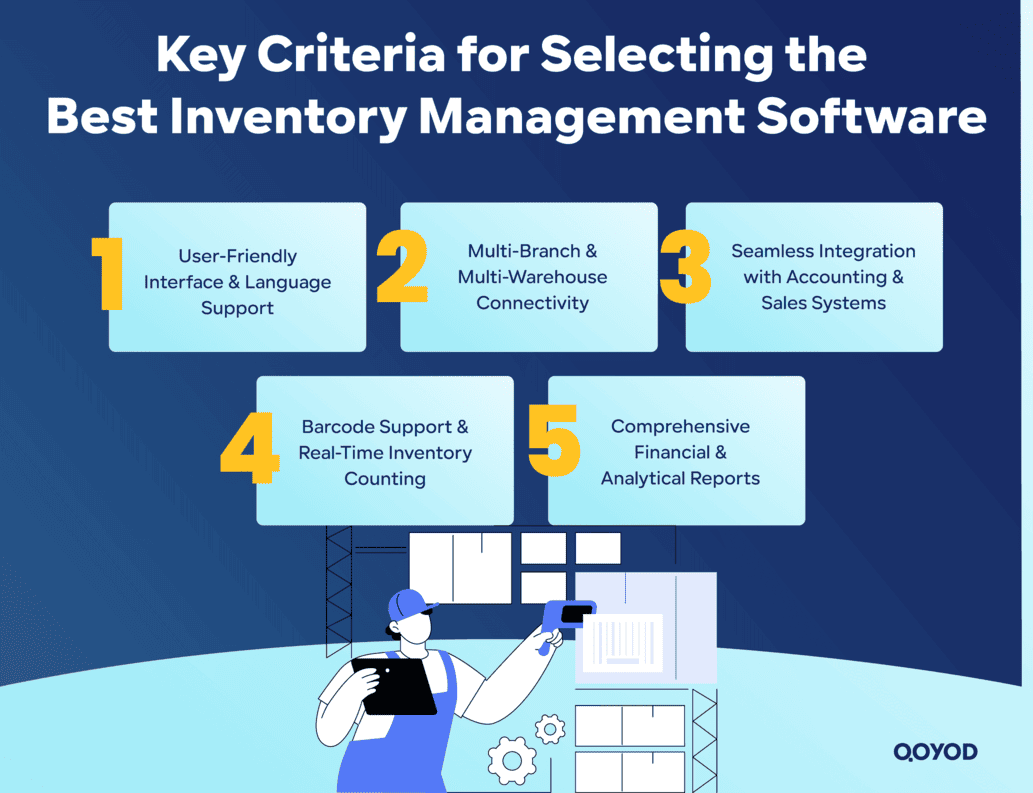
User-Friendly Interface and Language Support
The software must have a clear and simple user interface that facilitates daily operations without complexity, making it easy for staff to adopt.
- Qoyod is characterized by providing a fully supported, easy-to-design user interface suitable for all user levels, which enhances performance speed and reduces operational errors.
Multi-Branch and Multi-Warehouse Connectivity
The software’s ability to manage multiple branches and warehouses in an integrated manner allows for centralized inventory monitoring and easy flow of items between storage locations without data loss.
- Qoyod offers an advanced linking system between different branches and warehouses, enabling real-time tracking of movements and reports while maintaining the integrity of the administrative process.
Integration with Accounting and Sales Software
The inventory program must seamlessly integrate with accounting and sales systems to unify financial and administrative operations and ensure data accuracy across all company departments.
- Qoyod supports full integration with its accounting system components, including inventory items, invoices, and accounts, which enhances operational accuracy and provides precise analytical financial reports.
Barcode Support and Real-Time Inventory Count
It is essential to support barcode technologies to improve the speed and accuracy of receiving, issuance, and counting processes, along with the possibility of real-time inventory counts for instant quantity updates.
- Qoyod Accounting Software can handle barcodes and instant inventory updates, which simplifies counting processes, saves labor time and effort, and improves report accuracy.
Financial and Analytical Reports
A comprehensive system for preparing financial and dedicated inventory management reports is necessary, such as inventory turnover analysis, spoilage reports, and cost tracking, ensuring decisions are based on accurate data.
- Qoyod provides a wide range of customizable financial and analytical reports that enable management to monitor performance and analyze data to make informed strategic decisions.
In Conclusion:
Choosing inventory management software must be based on clear criteria that align with the local business environment and financial control standards. It must offer ease of use and advanced features such as integration with cloud accounting systems, barcode support, and pivotal reporting. Qoyod is an excellent option, combining these criteria with flexibility for scaling and customization, making it an effective tool for improving inventory management efficiency and achieving necessary compliance while enhancing operational performance.
Tips for Choosing the Optimal Inventory Solution for Your Business
When selecting the most suitable solution for your warehouse, we provide a set of practical tips and evaluation stages to ensure you choose the right software efficiently, with a focus on security and continuous updates.
Tips for Selecting the Best Inventory Solution
- Accurately Define Business Needs: It’s important to start with a comprehensive understanding of inventory volume, number of branches, and the nature of the business. Qoyod offers customization flexibility to suit your business size, whether you are a small or large organization, with tools to manage multiple warehouses and link branches seamlessly.
- Ease of Use and User Experience (UX): Choose a program with a clear and easy-to-use interface that allows employees to operate the system without complexity, reducing training time and increasing processing speed.
- Integration with Financial and Administrative Systems: Through seamless integration with Qoyod’s accounting module, you can combine inventory operations with accounting and financial processes, which enhances data accuracy, facilitates the issuance of specialized and instant reports, and helps management make data-driven decisions.
Stages of Program Evaluation and Trial Before Purchase
| Stage | Action & Benefit |
| Research and Information Gathering | Review available features and functionalities, and benefit from customer reviews and previous experiences. |
| Use of Trial Versions (Free Trial) | Qoyod Accounting Software offers a 14-day free trial period, allowing the user to test all inventory management functionalities, including setting up entries, orders, and count reports, ensuring the choice is supported by practical experience. |
| Technical Support and Training Assessment | Assess the provider’s efficiency in offering continuous technical support and training programs to maximize system utilization. |
| Security and Data Protection Testing | Ensure mechanisms are in place to protect data from loss and breaches, and a backup policy is implemented, which is a key feature for Qoyod users to guarantee data safety. |
Security Considerations and Continuous Updates
- Continuous Updates for Compliance: Qoyod provides periodic updates to ensure compliance with the latest tax systems and local regulations, safeguarding your company from legal complications.
- Data Protection and Access Security: Qoyod utilizes advanced data encryption technologies and allows for managing access permissions for different users to ensure the confidentiality and security of information.
Through these tips, stages, and continuous support, Qoyod provides a comprehensive and robust environment for inventory management within an integrated ecosystem that improves operational efficiency and reduces errors, while ensuring security and legal compliance.
9 Common Questions About Inventory Manager Roles and Best Inventory Management Software
What are the main responsibilities of an inventory manager?
An inventory manager is responsible for receiving and recording goods, organizing and arranging inventory, performing periodic counts, monitoring stock levels, adhering to safety protocols, coordinating with different departments, and accurately documenting all movements.
Why is professional inventory management important?
It reduces waste and loss, achieves control over assets, supports sales and purchasing operations, and improves workflow and productivity while reducing costs and failures.
What is the difference between traditional and digital inventory management?
Traditional management relies on manual, paper-based work, making it prone to errors and delays. Digital automation provides real-time tracking, higher accuracy, advanced reporting, and integration with other systems.
What are the criteria for choosing inventory management software?
It should support ease of use, link multiple branches, integrate with accounting software, support barcode technology, and provide accurate financial and analytical reports.
How can inventory management software be evaluated before purchase?
Review features, use free trial versions, test technical support, evaluate security, check integration with other systems, and define a clear implementation plan.
How does Qoyod Accounting Software support inventory management?
It offers tools for product management, real-time inventory counts, documentation, accounting integration, and continuous updates compatible with global best practices.
What is the role of barcodes in inventory management?
It facilitates the counting process, speeds up data entry, reduces human errors, and allows for accurate and real-time inventory tracking and control.
How do financial reports contribute to inventory management?
They enable management to monitor performance, analyze sales, identify the most profitable items, and make smart storage and purchasing decisions.
What are the biggest challenges in traditional inventory management?
Inaccuracy, data loss, operational delays, heavy manual labor, and poor utilization of space, which modern digital systems address.
At Sum Up:
Inventory management is no longer a peripheral task but a core strategic function for small and medium-sized businesses globally. By adopting a modern approach and leveraging digital automation, you can shift from reactive stock keeping to proactive, data-driven management. This guide highlighted the fundamental role of the inventory manager and the essential features your business needs in the best inventory management software to achieve accuracy, compliance, and efficiency.
Try Qoyod Accounting Software now to make your business operations easier and more accurate with solutions designed for modern businesses.