| Excerpt: | Don’t lose track of your payments! Discover the official process for Payment Order inquiries on Etimad, and leverage Qoyod to efficiently manage and follow up on all your outstanding receivables. |
Are you stuck in a waiting loop? Has a government entity or a private institution issued your invoice, only for it to turn into an “unknown” figure within the financial systems? Tracking financial dues is the lifeblood of any business or financial commitment. In the Kingdom of Saudi Arabia, where the pace of digital transformation, including the e-invoicing system in Saudi Arabia, is rapid, it is no longer acceptable for the process of checking Payment Orders to be vague or complicated.
If you are looking for reliable and direct information on the status of your outstanding payment, you are in the right place. Starting from the details of checking a Payment Order with the Ministry of Finance (MOF) via the Etimad portal, to how efficiently manage these orders within your establishment using software like Qoyod Accounting Software, we provide a comprehensive guide that ends the guesswork. Get your payment order number ready, and let us discover the official steps that secure your financial rights and make checking Payment Orders a fast and transparent task.
What is a “Payment Order” and Why Do Businesses Need to Check its Status?
The process of checking Payment Orders is the first step to ensure you receive your financial dues on time. In the modern Saudi economy, which relies on sophisticated digital financial systems, understanding the Payment Order and how to check it with the Ministry of Finance is vital for citizens and establishments alike. Both individuals and small/medium-sized businesses (SMEs in Riyadh, Jeddah, Dammam, and Khobar) need to check a Payment Order to confirm the status of dues, know the expected payment date, and avoid any delays that might affect their cash flow.
Definition of a Payment Order
A Payment Order is an official financial document issued by a party (usually the debtor entity or the Ministry of Finance) directed to the bank or public treasury to disburse a specified sum of money to another party (the beneficiary), whether an individual or an establishment. In short, it is an “official approval” to transfer the funds. Once issued, the beneficiary can start the procedure of checking Payment Orders to track the arrival of their dues.
The Difference Between a Payment Order and a Receipt Order
In financial and accounting operations, there are two fundamental terms that must be distinguished:
| Concept | Payment Order | Receipt Order |
| Definition | An order issued for disbursement and transfer of money from the issuing entity to the beneficiary. | An order issued to collect money and deposit it into the account of the issuing entity from another party (the payer). |
| Financial Flow | Money flowing out of the issuing entity. | Money flowing into the collecting entity. |
| Beneficiary | The person or company that receives the money. | The Treasury or the account of the entity that receives the money. |
| Inquiry | Done by the beneficiary to track the arrival of their dues (Check Payment Order). | Done by the collecting entity to ensure the required amounts have arrived (Check Receipt Order). |
How to Check Payment Order Status with the Saudi Ministry of Finance
The Saudi Ministry of Finance (MOF) is the primary authority responsible for issuing government Payment Orders. The Ministry has digitally facilitated this process through its sophisticated financial system, which aims to simplify the process of checking a Payment Order for all beneficiaries. The Etimad platform is the most important gateway for this purpose.
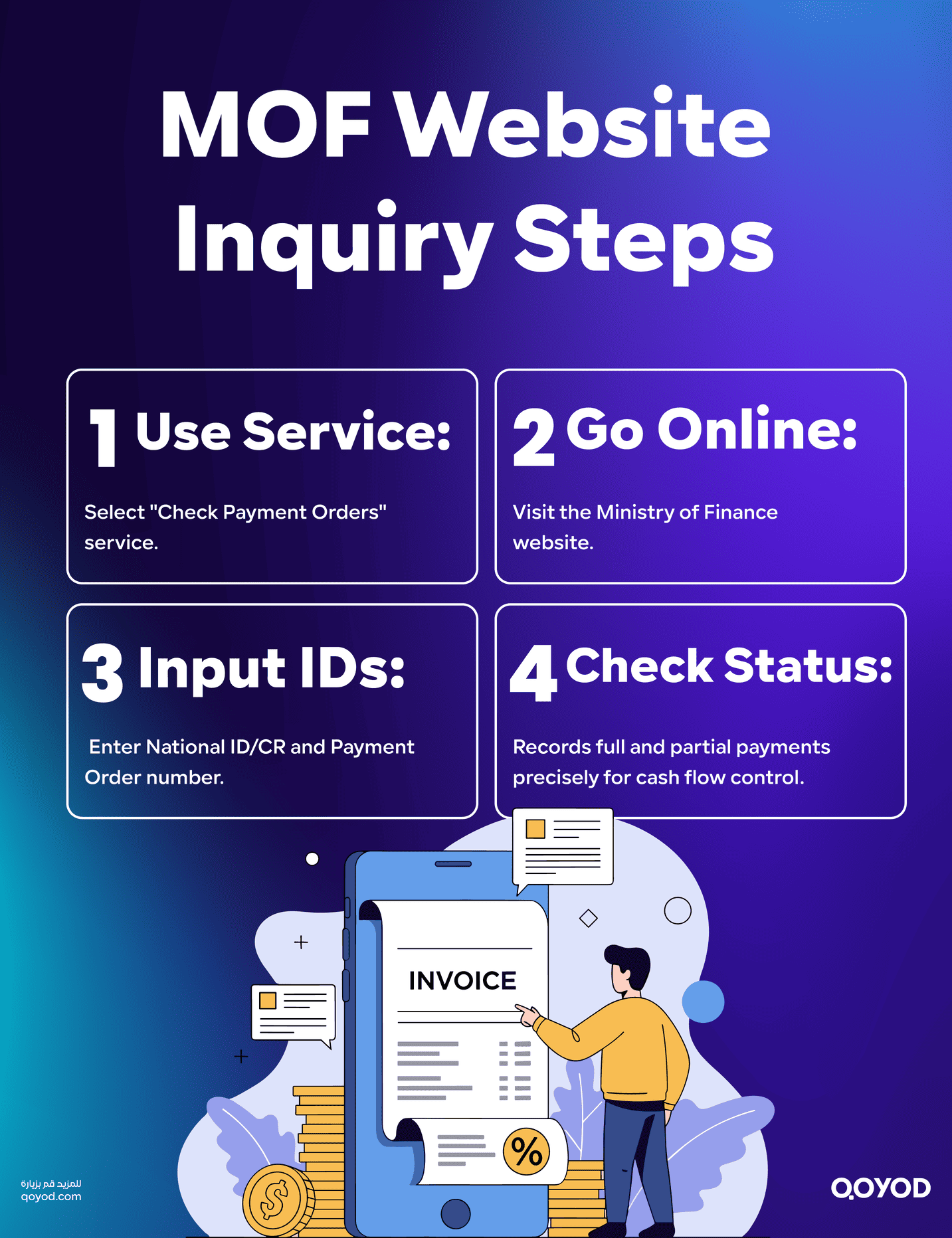
Steps for Inquiry via the MOF Website
While Etimad is the most prominent interface, some basic inquiries can still be performed via the official government websites:
- Access the official website of the Saudi Ministry of Finance.
- Search for the service “Payments Inquiry” or “Check Payment Orders“.
- Enter the required data: This usually includes the National ID/Iqama number or Commercial Registration (CR) along with the Payment Order number, if available.
- View the Result: The system displays the status of the Payment Order (Under Process, Disbursed, or Cancelled).
Inquiry Through the “Etimad” Platform
The Etimad platform is the unified system launched by the MOF to regulate government financial procedures. It is the most efficient tool to Check Payment Orders for establishments and individuals dealing with government entities across Saudi Arabia:
- Registration and Login: The beneficiary must register on the Etimad platform as an individual or an establishment via the National Single Sign-On (Nafath).
- Access Services: From the main menu, select “Financial Services” or “Payments.”
- Payment Order Inquiry Service: Click on the icon for “Check Payment Orders“.
- Filter Search: You can search using:
- A specific Payment Order number.
- The granting government entity’s number.
- The order’s issue date.
- Review Details: The platform displays the order’s status and its actual or expected disbursement date.
Practical Tip: When dealing with the Ministry of Finance Payment Order inquiry, always keep a copy of the Payment Order number and its issue date to ensure quick inquiry via Etimad.
Tracking Payment Orders in the Private Sector and for SMEs
The need to Check Payment Orders is not limited to government entities. Private companies and, specifically, small/medium-sized businesses (SMEs) need an effective mechanism to track payments due from their customers or other parties. This mechanism ensures the health of cash flow and business continuity, especially for growing businesses in economic hubs like Jeddah and Madinah.
How to Track Payment Orders in Accounting Software
In the private sector, the concept of a government Payment Order is replaced by concepts like “Disbursement Vouchers” or “Outstanding Sales Invoices.” These orders are managed and tracked effectively through modern cloud-based accounting systems:
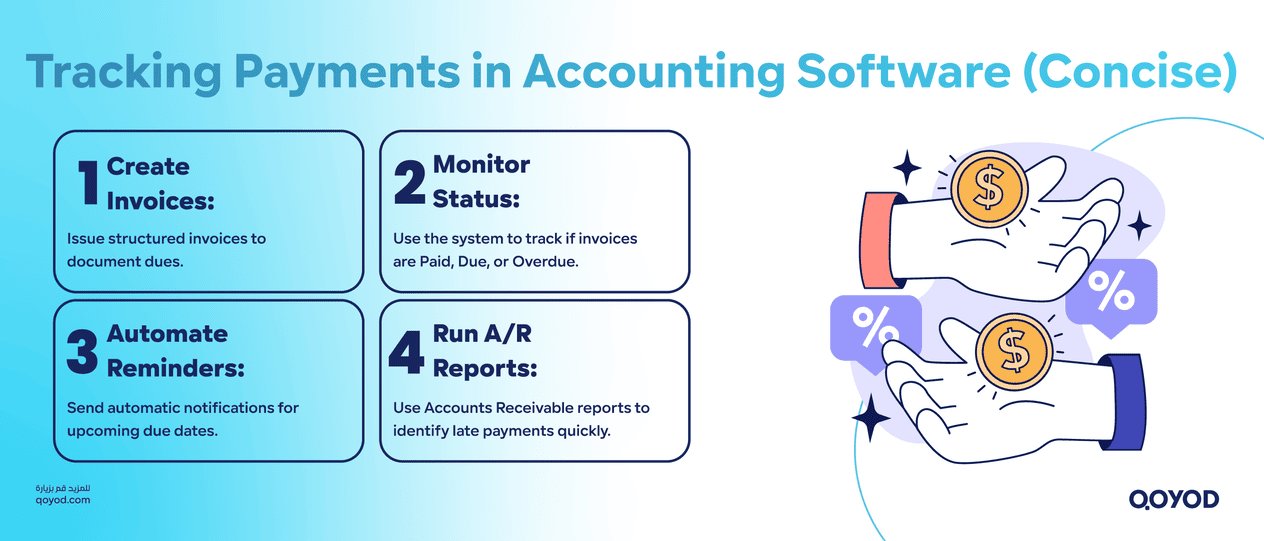
- Invoice Creation: Issue structured sales invoices to document the financial dues from customers, adhering to the e-invoicing system in Saudi Arabia (ZATCA regulations).
- Track Invoice Status: Clearly label the invoice status (Outstanding, Overdue, Partially Paid, Fully Paid).
- Reminder Notifications: Send automated notifications to customers about due Payment Orders (invoices) for payment.
- Accounts Receivable Reports: Use Accounts Receivable reports to know who owes the company and when to inquire about delayed payments.
These programs, like Qoyod Accounting Software, make the process of checking the company’s payments an internal and direct operation without the need for an external party, significantly boosting collection efficiency. This is the Best accounting software in Saudi Arabia for cash flow visibility.
Integrating Qoyod Accounting Software with Government Payments
For establishments dealing with government entities and using accounting software like Qoyod, the process of managing a Payment Order inquiry becomes smoother and more integrated. You can benefit from these advantages:
- Government Invoice Tracking: Issue the necessary invoices to government entities via Qoyod and track them.
- Data Unification: After successfully checking the Ministry of Finance Payment Order status via Etimad, the payment status and Payment Order number (if available) are entered into the Qoyod accounting system.
- Cash Flow Reports: Qoyod processes this data to provide accurate reports on expected and received payments, linking internal financial performance with the status of government Payment Orders.
Qoyod Tip: Qoyod Accounting Software enables accountants and financial managers to link revenue and expenditure data, making it easier for them to know the financial position accurately after checking government Payment Orders, thus facilitating future budget planning.
Practical Advice for a Successful Inquiry and Avoiding Common Errors
To ensure the success of the Check Payment Order process and avoid unnecessary delays in receiving your dues, you must follow practical advice. These tips ensure data accuracy and speed in obtaining results, especially when dealing with the Ministry of Finance Payment Order (MOF).
Accurate Use of the Payment Order Number
The Payment Order number is the main key to the process of checking Payment Orders. You must ensure the following:
- Number Match: Make sure the number you use to search on the Etimad platform exactly matches the number issued by the government entity or the paying party.
- Avoid Typos: Any error in the Payment Order number,whether a missing or extra digit or a mistake in related characters will result in a “Not Found” or “No Dues” result.
Verification of Identity and Documents
Before starting a Payment Order inquiry, ensure the integrity of your basic data, as a large part of inquiry failure is due to identity issues:
- Data Update: Ensure that the National ID/Iqama or Commercial Registration (CR) number recorded with the government entity is the same one used in your Etimad account.
- Bank IBAN: Your bank account number (IBAN) must be registered and approved by the paying entity to avoid payment suspension even after successful Payment Order inquiries.
The Impact of Checking a Payment Order on Your Company’s Cash Flow
The process of checking a Payment Order is not merely a procedural step; it is a vital and effective tool for cash flow management and financial liquidity planning for the company:
- Immediate Planning: Knowing the expected disbursement date of the Payment Order enables you to plan ahead to settle your obligations (salaries, rent, supplier payments) on time. This is key for Accounting solutions for Riyadh businesses.
- Negotiate with Confidence: When you know the status of the expected Payment Order, you can negotiate with confidence with your suppliers regarding payment dates, which enhances your company’s financial reputation.
Ready for the 2nd phase of E-invoicing?
Use Qoyod to generate and send invoices
Frequently Asked Questions (FAQ) about Checking a Payment Order
What is the fastest way to check a Payment Order in Saudi Arabia?
The fastest and most accurate platform is the Etimad platform, part of the Ministry of Finance. Log in and use your National ID/CR and the Payment Order number (if available) for immediate results.
How long does it take to disburse a Payment Order after issuance?
The duration varies, but typically it takes a few working days (usually 1-5 working days) after the Payment Order is finally approved in Etimad and transferred to the Saudi Central Bank (SAMA).
Can I check a Receipt Order in the private sector?
Yes, this is done internally. In the private sector, you check a Receipt Order through your accounting system (Qoyod Accounting Software) by tracking the status of outstanding and settled sales invoices from customers.
What is the essential difference between a Payment Order and a Receipt Order?
A Payment Order is authorization to disburse money from the issuing entity to you. A Receipt Order is authorization to collect money and deposit it into the collecting entity's account.
Conclusion: Transform Your Inquiry into Successful Financial Management
The ability to efficiently Check Payment Order status is a fundamental pillar of successful financial management in the Kingdom of Saudi Arabia, whether you are an individual or an SME owner. Digital systems, such as the Etimad platform, have greatly facilitated the process of checking the Ministry of Finance Payment Order, transforming it from a procedural maze into a quick and direct step.
However, to gain the maximum benefit from the Payment Order inquiry information, simply knowing the payment status is not enough. You must be able to immediately integrate this data into your accounting system to update your cash flow.
Don’t let Payment Orders get lost between papers or outside your system!
Start using Qoyod Accounting Software today to link your invoices and cash flows with the status of government Payment Order inquiries. With Qoyod, you can easily manage all your payments and receipts, saving time and effort, and ensuring you receive your dues accurately and on schedule, giving you a clear and continuous view of your financial position.
Try Qoyod Accounting Software now to make your business operations easier and more accurate with solutions designed for Saudi companies.
Sources and References
- Saudi Government Unified Portal (For checking Payment Orders)
- Etimad Platform – Financial Services
- National Center for Government Resources Systems (NCGR)